
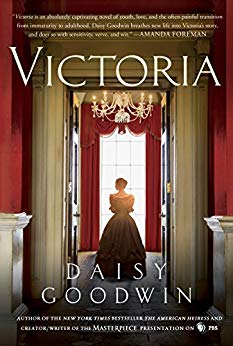
Victoria
For anyone who enjoys historical fiction, there’s a lot to enjoy about Victoria. However, for lovers of historical romance, there is less so. Ms. Goodwin’s novel follows the young queen from her coronation to her engagement to Albert and is as much about a young woman learning to be queen as it is about a young woman learning to be an adult. Of course, both of those elements mean learning about a choice in partner, but I would not term this book a romance.
I am an armchair historian at best, and while, as a scholar of colonialism and of women in leadership, I am interested in Victoria, I cannot claim to be anywhere near an expert. Thus, I have no idea if the Victoria presented by Ms. Goodwin is fully accurate, but it certainly fits with other accounts I’ve read or watched. What I present below is as much of an account of the life of the queen as presented in this book as it is about the book itself.
For anyone unfamiliar with this piece of British history, Victoria grew up incredibly sheltered by her mother and her mother’s advisor. The movie The Young Victoria starring a charming Emily Blunt and Rupert Friend tells this story as well, and I found myself flashing back to scenes in that movie. Victoria’s claim to the throne was as the niece of the ruling monarch (William IV) and her mother was constantly afraid she would be murdered by another claimant and uncle, the Duke of Cumberland, a man with a most unsavory reputation who was believed to have murdered his valet. This lead to Victoria having no contact with anyone else her own age, and no education about how to actually be queen.
As a result of being hidden away in Kensington Palace, when she is finally crowned, the first throes of Victoria’s rule are marked with scandal. She claims her birthright as queen and swings towards absolute power quickly, but fails to temper it with a proper understanding of her role in a constitutional monarchy. She relies deeply on her first Prime Minister, Lord Melbourne, who is nearly 30 years her senior, and conflates him into both a surrogate father and a possible lover. It is due to her infatuation with Melbourne that she refuses to court the idea of a husband, or grasp the idea of a change in power in the government.
Most of Victoria’s problems in this novel are her own, but at the same time, none of them are. She is such a victim of the decisions made by her mother in this phase of her life, and it is eventually Albert who brings balance to the capricious little girl who was crowned. We do spend some time with Albert, seeing how he questioned the maturity of Victoria, wondering if he could ever live with someone who was so interested in fripperies as she was. For me, this is the weakest part of the book, and it’s so disappointing, because this is the part I was looking forward to most. I wish we had spent a little less time with Lord M and a little more with Albert, as her decision to choose Albert came narratively out of left field. Not out of left field in her life, but in the crafting of the narrative of this book.
However, Victoria is a solid historical read overall. The immersion into this two year period of Victoria’s life allows for a focus that helps illustrate the rest of her (lengthy) reign. As an aside, this is the kind of book I would happily lose myself in in front of the fireplace on a snowbound weekend, so if you’re in one of those parts of the world prone to them, perhaps have this one on hand.
Buy it at Amazon/Apple Books/Barnes and Noble/Kobo
Recent Comments

How much of the Lord Melbourne (he was actually forty years older than her) thing is real? I know a lot of historians got VERY upset with that new miniseries when they made a teenager fall in love with a man of sixty. Now I see GIFs and fan sites all over the internet for this seriously creepy relationship television producers seem to be mostly responsible for inventing.
I don’t think they invented the relationship, although they definitely romanticised it. I remember reading Jean Plaidy’s The Queen and Lord M. back when I was in my teens, and that’s where I first read that Victoria had been dubbed “Mrs. Melbourne” because of her close relationship with him. I could certainly see that an impressionable, very sheltered young woman might have a massive crush on a worldly, older man, but I can’t see it was more than that.
Some people will ship anything! ;)