
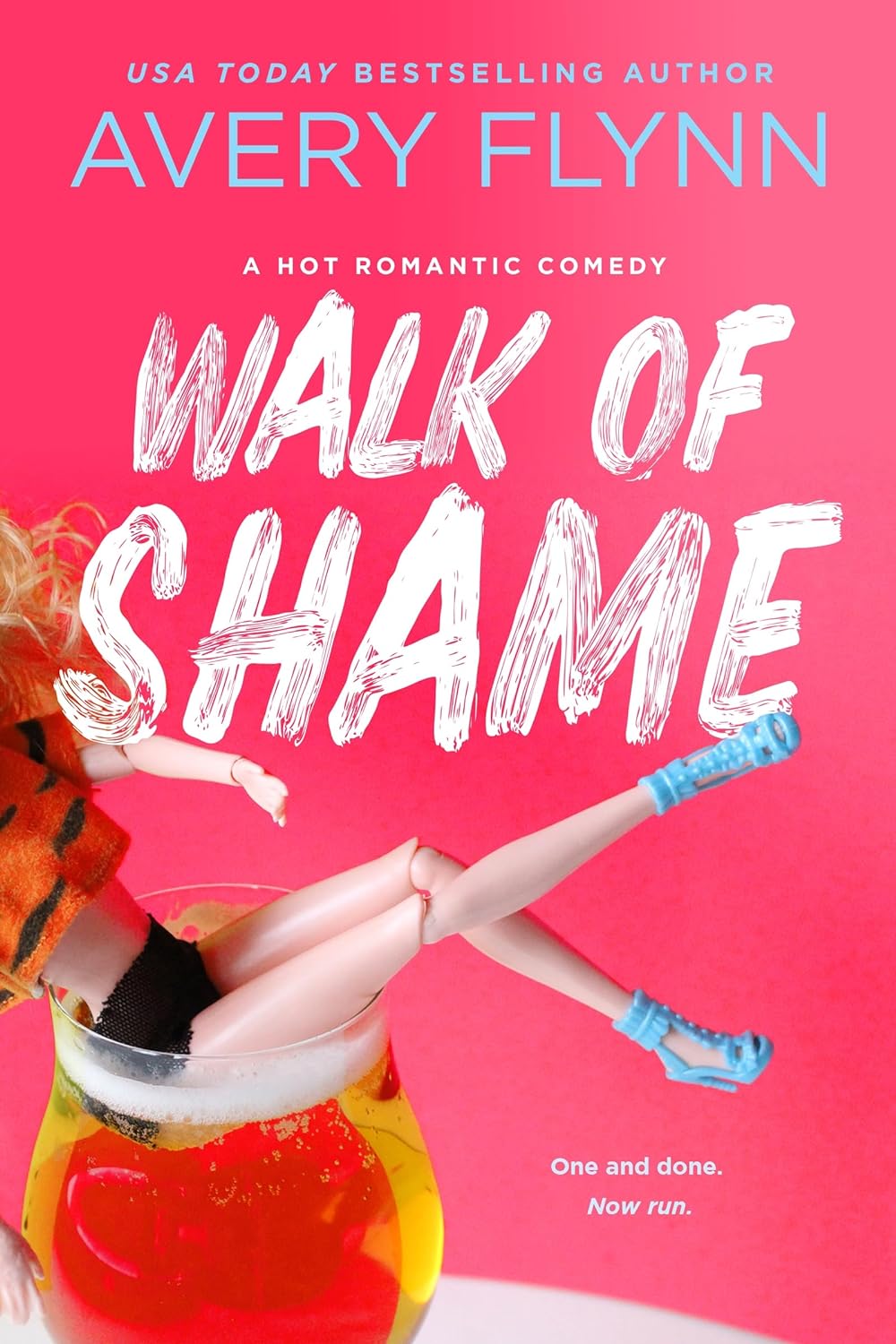
Walk of Shame
If you love smart hockey romances with leads that act like grownups and writing that shows a commitment to excellence, you, like me, will not enjoy this book.
Our heroine, Astrid, is yet another romance heroine with zero interest in romance. Five years ago, she was left at the altar by a hockey star and now she’s the poster child for commitment-phobia. She’s a one-night stands only type–she even has rules against eating food with the guys she screws. Whatever.
Her food resolution, however, is tested when Cal, the very hot and very unsmiley hockey-coach-with-a-heart-of-gold walks into the bar she’s working at. Not only can she not stop staring at his thighs (he’s equally obsessed with her deliciously thick ass), he wins her let me bang you as soon as possible favors when he physically puts down a guy who is arguing aggressively with Astrid about her rule that no one in the bar is allowed to discuss hockey. (This ban, in a bar in a hockey city, seemed absurd to me.) After a tiny bit of trite banter, the two agree to meet later in Cal’s apartment (this breaks another Astrid rule–don’t bang anyone in her building) for JUST SEX.
Astrid shows up, Cal talks extremely dirty, the two have sex and, shocker, it’s the best they’ve ever had, and now they want MOAR. But it’s complicated because Cal is in town to work with Astrid’s asshat ex who now plays for Astrid’s dad and Astrid is against love and hockey. What on earth will they do? I couldn’t have cared less.
Astrid and Cal are less like fully-fleshed characters and more like cardboard cutouts. Astrid’s whole “I hate hockey because my ex played it” shtick gets old real fast, and Cal’s relentless pursuit of her feels more cringeworthy than swoon-worthy. Both leads feel like early 20-somethings bumbling through life–it’s hard to take either of them or their manufactured angst at all seriously. I was especially irked that, though Astrid has a job, we learn nothing about her life outside her relationships. Oh, and the endless dampness of her panties.
And don’t even get me started on the writing. The plot’s predictable and the dialogue as subtle as a Chevy truck ad. And while the sex is copious and detailed, it’s not sexy nor does it reveal anything about the leads. Flynn has crammed in as much steaminess as possible without bothering with those little things like an interesting plot or believable character development.
Walk of Shame is less of a romantic journey and more of a stumble through a minefield of tired tropes and lackluster writing. To be honest, I skimmed the last half because I was so bored. I’ve not read Flynn before but we’ve given her Bs on two other books. So, either this one is much worse than her earlier stuff, she’s just not for me, or this book just sucks. Whatever the issue, this is gets a low C.
Recent Comments


These characters sound like empty nightmares whew!
Except for the obvious adult situations, Astrid sounds like she has the maturity of a child with the “no hockey talk” and “hate everything hockey” attitude, like it’s the game that’s the problem. This sounds like the epomite of what I hate about the “I don’t do love because I’ve been hurt” trope.
Though I’ve now been married for decades to the same guy, when I was younger I had my heart utterly trashed, once by an utter shithead of a man. But he taught me what I didn’t want, not that relationships should be avoided. I think it was easier for my generation–we all planned to get married and have kids when we were in our early 20s and so it seemed inherent that I would keep looking. But, again, this is my own experience and I understand that many younger women see intimacy as far harder today.
I always admired the US ability to fail and try again. At least, I was told that this is American:
We had courses in economics (here in Central Europe) where economists argued that in our region, if you go bankrupt, you are so ashamed that you never try again. And if you wanted to, nobody would give you money to do so, since they would not believe you able. While in US, a lot of super successful people had one or two failures (with financial losses) in their history, but tried again, and found backers, again.
I just thought of this, since we are currently debating this „failed, so never again“ attitude in relationships, and like you said, it just makes no sense at all. What else should we never do again do to a first bad experience? Seek employment? Repeat an exam? Put a nail in the wall? Iron a shirt?
Though maybe Dabney has it right, and we just could not imagine life without a family of our own, in our teenage/twenties. I only could in my late forties, imagine not to start again with a new guy.
I’m actually talking more about it as a romance trope, not necessarily what goes on in real life. IRL is incredibly nuanced. (From talks with my kids and their friends (20’s to almost 40) one of the biggest problem they’re having is simply meeting someone.) Obviously we’re reading romance fiction, and I honestly don’t expect every nuance of a trope to be explored every time. At the same time, I do expect some effort to make the situation ring true and what is described here is certainly doesn’t sound like that. “I’ve been hurt and will never love again” or some other one dimentional reasoning is lazy and overused, in my opinion.
I actually don’t mind this trope when it’s well done. There certainly are reasons to be wary of trusting again. I’m reading a novella right now that’s rather lightheated, but one of the MC’s had a difficult upbringing and a failed relationship which have knocked his confidence level and make him wary of a new realtionship. Even in this short form the author has made it feel believable. It can be done. :-)
Carrie said what I was thinking. This trope can be one of my favorites when it’s done well, partly because it’s close to home, but when it’s not done well, it results in immature characters who don’t act like real people, like this anti-hockey vendetta.
I think I want to say that for it to work, the author can’t treat it like a trope?, because as Carrie said, IRL this is extremely nuanced and layered and can have less to do with the relationship gone bad than with the other details of the person’s biography. It can make for a wonderful read when the author takes the time and care to delve deep into the character’s psychology and history, unpeel the layers, and show why the other character is able to reach them, but far too many authors use it as a simplistic plot device, and then it’s uninteresting at best.
I agree, the problem is when authors treat this as a trope. So there’s a duke who’s rich, powerful, gorgeous and adored by his family, but he needs to have a flaw/vulnerability, so he gets commitment-phobia like a card dealt to him from a pack. It doesn’t mesh with the rest of his characteristics, it’s not part of a well-developed and holistic whole, and so it comes off as immature and unrealistic.
I looked at the romances on my keeper shelf to find a book which did this trope well, and Simple Jess caught my eye at once. The widowed heroine refuses to remarry, because after her mother died when the heroine was a child, she was passed from one distant relative to another. She’s determined her young son will never be in such a position, neglected because a stepfather would care more about his biological children. For me, that’s a much more interesting and sympathetic reason to avoid relationships than the simplistic “My life is great in every other respect, but I was dumped five years ago therefore I Will Never Love”.
Promises of Forever by Nicky James (m/m published 2024), Until You and And Then You, both by Briar Prescott (m/m published last year) are three of the best books I’ve ever read with this sort of underlying theme.
You and Star are both spot on because what makes it work is that in all these books it isn’t a “trope,” it a real backstory which in both cases is traumatic and life changing.
Sheer morbid curiosity made me check this out on Amazon. If I’m not hooked by the story, I notice the author’s writing tics, and here’s one that jumped out at me.
The author is probably going for a breathless, hyperbolic style, but the repetition doesn’t do the book any favors. By this point I was just reading to see when the next “million” would pop up.
And there it was!