
It Is a Truth Universally Acknowledged… That Context Changes Everything
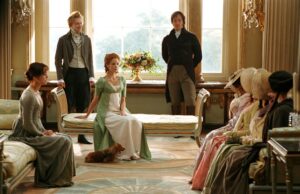 I love to watch reaction videos on YouTube (movies and music). There is something so satisfying in watching someone–especially young people–discover something that I already love. I really enjoy when big, manly men watch chick-flicks, romances and/or historical dramas that they would stereotypically never watch, only to be absolutely blown away by what they’ve just seen.
The other day, I was watching two early-twenty-something girls react to the 2005 Joe Wright-directed Pride & Prejudice film. Neither girl had read the book, but any time someone is introduced to the brilliance of Jane Austen in any form, I’m thrilled.
However, this one exchange stopped me cold. The scene takes place the morning after the Country Dance (when the Bennets meet Bingley and Darcy) and the family is sitting around the breakfast table. While watching, the two girls commented as follows (edited for clarity):
Watcher One: Who is he? [talking about Mr. Bennet played by Donald Sutherland] Is he their grandpa? They [the Bennet girls] say papa, but she’s [Mrs. Bennet] calling him Mr. Bennet.
Watcher Two: Oh … so it must be …why is she calling him Mr. Bennet? Is that how you address your husband … your hubby? Or maybe it’s ‘cuz he’s a lot older looking than her. Maybe he’s the grandpa, like her in-law.
So basically, they were confused as to why Mrs. Bennet was addressing Mr. Bennet in such a formal manner, guessing it was because he was Mrs. Bennet’s father-in-law.
The same girls had a lot of confusion over the problem with Lydia running away with Mr. Wickham. When it was revealed that Wickham was paid a large sum of money to entice him to marry Lydia, they conjectured that Wickham had kidnapped her and held her for ransom.
I watched another reaction video of that same movie, this time by two men I would guess to be in their thirties, and they also had a lot of confusion over the Lydia/Wickham scandal. They figured the reason Wickham got the money was because it was Lydia’s dowry.
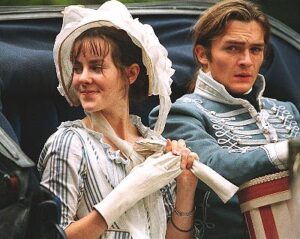 Neither of these two pairs of reviewers understood that running off and cohabitating with a man out of wedlock, and then not marrying said man, meant that Lydia’s reputation would be completely destroyed, and by association, the reputation and honor of her entire family would be ruined as well.
I find this often when (usually young) people discover Austen; their lack of context and familiarity with the social mores of Regency England cause them confusion or misinterpretation of the events or actions of the characters. And while I’m so glad they are discovering the story, I usually want to reach through the screen and shake them and say “No! This is a big deal because XYZ!” and explain to them what’s really happening.
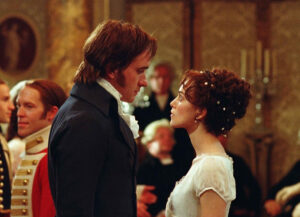 Another group – four men in their forties – watched P&P 2005, and they absolutely loved the film (yay!). All except one guy, who, when giving his final analysis, complained that it wasn’t believable that Darcy and Elizabeth would fall in love because they barely spent any time together. He applied the dating habits and expectations of our modern times to their love story and couldn’t fathom that this was the way people courted back in Austen’s time.
All this to say, I find it fascinating how much familiarity with the time and place a story was originally written gives you the context necessary for truly understanding it. While it’s clear by the examples above that knowing everything isn’t necessary to enjoy a book (or film), I have to believe that to truly ‘get’ it, such information is key.
Then I began to wonder how it is that we obtain that context. I certainly don’t recall in any class (either high school or college) discussing the social protocols of Regency England, and yet I do know a lot about it. I suppose it is through exposure in reading and a general interest in the topic? I take for granted that what is so obvious to me is not common knowledge to others. Of course Mrs. Bennet calls her husband Mr. Bennet. Of course Wickham must be made to marry Lydia. Of course Darcy and Elizabeth can fall in love while dancing! How do these viewers not know these things?!
Finally, perhaps this observation could be used as an argument of why liberal education is still so important. Given the push by so many to eradicate ‘useless’ degrees in things such as Literature, Humanities, History, Philosophy, etc., it seems that losing this context would be more than unfortunate
I would love to hear your thoughts in the comments. Is there a situation you can recall where your enjoyment of something changed once you had a better grasp on the context? Do you, like me, want to ‘context-splain’ to everyone when they don’t seem to get it?

This is a belated follow-up on the education issue.
Ponder the intersection of these 3 lines:
You can lead a horse to water, but you can’t make it drink.
When the student is ready, the teacher will appear.
Education in the U.S. is compulsory into the teens (with the age limit varying by state).
Two most obvious purposes of primary and secondary education are to enculturate children and to teach them basic literacy and numeracy needed to function in modern society. These are essentials of a culture and the people in it. Hence, compulsory education. Voluntary post-secondary education is for vocational or liberal (free person) arts or other knowledge beyond the minimum covered in secondary education.
The basic problem with compulsory education is that it is fighting against human nature. Students compelled to sit in a class they are not interested in or mentally ready for will learn much less than students who are studying something they CHOSE because they are interested. The teachers may dole out knowledge like a gardener sprinkling water, but most of it will run off unabsorbed by unwilling / uninterested / unready students.
Unfortunately, I don’t have a solution to propose. The societal and personal need for education is real and urgent, but any form of compulsory mass education short of the personalized distributed education that is a staple in some science fiction will always fall short due to human nature. We just need to remember this in discussions of education and not blame schools or teachers or students.
Reading older books written in different times is important. We have now expurgated a ton of the “classics” from the typical kid’s required reading in school because of “problematic” bits and because the writing is considered “over their level.” This means a lot of kids get to adulthood having never read anything substantial written in a different period. Kids also aren’t learning about history because a lot of history is objectionable. As a result, they live in a kind of ahistorical bubble. It’s scary, in my opinion.
I too, enjoy reaction videos for the same reason that you do – watching someone else engage with and enjoy a show/movie that I’ve enjoyed is fun for me. Sometimes, the person(s) reacting, will see a scene in a different way than I did and I’ll go back and rewatch the scene so I can see if I agree or not.
I find that I agree with the one man (out of the four who watched) & said it wasn’t believable to him that Darcy and Elizabeth would fall in love that quickly having not spent much time together. I love historical romances and have no problem with protagonists falling in love fairly quickly but the 2005 P&P version just didn’t do enough of a job to make me believe Darcy and Elizabeth were in love. It’s probably a me-problem & the Colin Firth/Jennifer Ehrle version might work better for me, I’ll have to check it out and find out.
While, I’d always had the idea that in times past, people lived and had different customs and mores to what we have now, it wasn’t until I began to read HR and subsequently began to Google & read blog posts about forms of address, clothing, calling cards, modes of transportation etc that I was able to understand the context of what was being written/acted about in the HR genre.
The Colin Firth/Jennifer Ehrle version does a much better job with the story overall as well as the romance. Definitely give it a try.
I’ll always argue that the 2005 version is the best because I think it is the most romantic. And for the past twenty years, that question has riled people up! Most younger people love it and find the mini-series too long which tracks with the phone generation.
Falling in love very quickly is remarkably common, especially in older generations. I know so many couples, all over 55, that decided to marry after just a few dates and most of those marriages lasted. I remain convinced that the true secret to staying together is intent and stress level rather than how well you knew your partner when you tied the knot.
IMO, the 1995 version is the definitive one, no question :) I like Matthew McFad. as an actor, but he’s not a Darcy. Also, I can’t stand Keira Knightley – she always looks like she’s speaking through clenched teeth!
So you’ve said!
Maybe I don’t hang out with enough young people, but I definitely don’t know anyone (apart from Dabney) who even likes the 2005 version. I did think it showed more sexual chemistry between Darcy/Elizabeth, which is ironic given that McFaden/Knightley weren’t in a relationship and Ehrle/Firth lived together for several years. I’ll add that it’s frightening to me to think that people who can’t sit through several hours of a mini-series would, in this country, be considered qualified to sit on a jury and make judgments on a legal case. *shudder*
I am your opposite, Caz. I like Knightley but McFad delivers the same performance regardless of role. He was the same in Ripper Street as in MI-5, and the roles are centuries apart!
Sorry, Maggie, I really like both versions (for different reasons) and regularly watch both. Add me to your list and double your count of 2005 fans. ;-)
The set design and costumes in the 2005 version are infinitely more interesting than the 1995 production. (For example, the public assembly scene when Darcy first appears in the 2005 version – in which the room is far plainer and way more crowded – is much closer to my own imagination when I read the book.) And I’ve always thought the older, “prettier” sister casting choice in the 1995 version to be problematic, as another example. Rosamund Pike’s Jane in the 2005 production is more conventionally “pretty” (dress, hairstyle, etc.) than Kiera Knightly’s Elizabeth. I also enjoy various actors’ portrayals in the 2005 production beyond the MCs: Maggie Smith, Donald Sutherland, Brenda Blethyn, Carey Mulligan . . .
The 1995 version – being 3x as long – clearly has the time to more fully explore all the characters actions and motivations, including the changing nature of the MCs relationship. I love watching this version too and wonder every time how the 2005 could be so short and tell the same story. But clearly I fill in all those details automatically when I watch the 2005 version.
So many people like it better!
https://www.dailytargum.com/article/pride-and-prejudice-2005-turns-20-pride-and-prejudice-film-adaptations-ranked-most-ardently-20250415
https://screenrant.com/pride-and-prejudice-best-adaptations-ranked/
I’m not surprised that Screenrant and Bookriot put 1995 first, while smaller sites/publications put 2005 first. I was surprised to see the Lizzie Bennett Diaries mentioned repeatedly. They aren’t something you hear too much about anymore. And I loved that Bookriot had Bride and Prejudice above 2005. I thought I was more or less alone in my love of that particular adaptation.
Knightly makes Lizzie so silly in a couple of scenes and that isn’t how she would have acted. Like the scene when she finds out about Lydia–Knightly paces around sniveling and making a scene, something Lizzie would never have done. She was way too properly bred. Just look at the way she reacts to her over-the-top mother. And I thought Mc Fadden was mostly wooden. Some of the side characters were great, though.
It’s definitely a mix of good and bad. I actually liked Donald Sutherland’s portrayal of the father. He wasn’t era-appropriate, but Sutherland infused him with an affability and congeniality that made Lizzie’s devotion to him understandable, and yes, some of the side characters were amazingly well done. But the story hinges on Elizabeth and Darcy, and as you said, Knightly and Mac weren’t quite up to portraying those characters.
Different strokes!
this may be the most controversial take ever on this blog, haha! I find the 1995 one absolutely romantic. I have never been a fan of the 2005 one, which feels very forgettable.
I’ll weigh in. I actually love both versions because I view them as very separate entities. I love – LOVE – the 1995 BBC version for its faithfulness to the book. I believe it’s the one that Austen meant to tell – or at least most closely. I think Firth’s Darcy embodies the real Darcy far better than Matthew McFad’s version (Darcy as standoffish because he’s shy/introverted/socially awkward is not Darcy, IMO). BUT – I do adore the 2005 version because it is very, very romantic and swoony. The cinematography is stunning, and the entire vibe is so much more “real” and gritty. It’s a great TL;DR version, a great introduction to Austen for those who have never experienced her before. Both versions sit high on top of my favorites lists.
Edited to add: one thing that I cannot stand – I mean I loathe with a passion – is Jenna Malone’s portrayal of Lydia Bennet in the 2005 version. Her acting is atrocious and she’s so miscast. Too, they give such short-shrift to this entire story thread it is a crime because it makes everything confusing.
I think both versions are marvelous and your analysis reflects how I feel too!
I have always enjoyed learning about different cultural contexts by reading fiction, from Rosemary Sutcliffe when I was a child to Georgette Heyer in my teen years and many different authors since. Much of my historical knowledge has come from fiction. The problem with that is that I find myself second-guessing my knowledge and wondering whether it is based in historical fact or derived from fictional representations of those times.
I don’t need to wonder about the historical accuracy of Jane Austen’s fiction, which was written about her contemporary times for a contemporary audience. However, I wonder whether she is less accessible than more recent writers of historical fiction to 21st Century audiences because she didn’t need to set the scene for her audiences.
I think that’s a good point about Austen. I know Georgette Heyer goes into a lot of detail in her romances and historicals: clothing, furnishings, manners, etc. But in her contemporary mysteries those details are relatively sparse. Why go into intricate details of what contemporary readers would have been familiar?
I don’t believe I ever had a class (literature, history or otherwise) that spent any time on the specific social mores of any particular time period (e.g. that married people called one another by a “title” rather than a first name when in the company of others, even family members). There isn’t time for that level of detail in most classrooms – and I don’t think there ever has been (I was educated in public schools in the US in the 60s and 70s, considered by many to be a golden age of public education). There is too much ground to cover in any given class to get to that level of specificity.
I picked up those kind of historical details the way most people do: from books and films and museum visits and travel and conversations with other people. How any given individual spends his or her “free” time in life will either increase or decrease the likelihood of their ability to understand the context in which anything else they might be reading or seeing or hearing was created. It is a much more general type of education. I don’t spend any time on social media to see the type of videos described by Jenna but it seems to me those are the same type of teachable moments humans have experienced for eons. It is also why becoming a life-long reader – with access to public libraries – is such a rewarding and foundational experience IMO.
I agree that one didn’t learn those sorts of details in school. But research shows that today’s students and graduates don’t have a grasp of most basic history–the context for those details. That’s alarming to me.
A lack of basic education in almost any subject concerns me as well; but as long as we are reluctant to “fail” students – either in specific subjects or for an entire school year, I see little chance for things to change.
I honestly can’t remember much about my history or English classes in high school. I can barely remember my math and science courses, which is what I was interested in at the time. I read more interesting books at home, including ones my father use to give to me after he read them. That’s how I came to read Les Mis and The Sound and the Fury. But I’m not particulary well read when it comes to “classics” and “best 100 books” lists.
These days I can’t really tell what I learned in school and what I learned teaching my kids. We did a literature based history curriculum in home school, so I know I gained much, much more from my exposure there than I did in school. I started the kids with Ancient Egypt and moved forward through time. One year we focused on the Eastern Hemisphere. Middle grade and YA fiction books are a fantastic way to learn a lot of basic information about life in historical times in a very captivating way. Many of them were Newberry books I’d never read.
I’m thinking that what understanding I may have of different cultural and historical mores comes more from learning and discussing alongside my kids (and other adults like my husband) than anything else. And teaching some of the material more than once didn’t hurt. By the time I’d found Jane Austen I had a decent grasp of the social strictures of the times.
Okay, I admit that videos like that irritate me, especially because those people are my age. I think it’s essential to understand from the start that a historical film won’t adhere to modern logic, and before judging, do your research! I partly blame “historical” shows like Bridgeton, which young people watch believing they’re historically accurate, and then they’re surprised when they discover how things really were. But ignorance isn’t something I like, especially ignorance that’s easy to spot… I’m no expert on the customs of ancient Asia, but at least I’m aware of that. And honestly, Darcy and Elizabeth didn’t fall in love just by dancing, but through deep conversations and truly observing each other, which doesn’t happen nowadays. Many people go on several dates talking about superficial things, eating, doing physical activities (romantic or sporting), only to complain later when they really observe their partner and discover they’re not who they thought they were, or that once married, they have nothing profound to talk about.
But what I find saddest is that apparently if you don’t force people to study something in school, they won’t do it on their own just to know.
I felt like my kids’ school experience made learning unfun. College was no better. I have sympathy for younger people who don’t, for example, enjoy reading fiction. If you look at most high school and college reading lists they’re almost all depressing reads. When I ask young people what their favorite college read was, they usually look at me blankly.
I loved much of what I was assigned to read in high school and college, very little of which my kids were assigned. And I had teachers that made learning interesting.
I blame our educational system in part for these issues.
I remember when I first read GONE WITH THE WIND (I was about 13): there’s a scene early in the book where Scarlett’s mother tells Scarlett’s father that she has to go to help a sick neighbor. In their exchange, they call each other “Mr. O’Hara” and “Mrs. O’Hara”—and I was momentarily baffled as to who they were to each other that they used formal address. Live and learn, lol.
When I had history class in junior high and high school (I am American and this was the 1970s-1980s), the focus was on major political and socioeconomic events. It was a lot to get through even just U.S. History in 2 semesters. We didn’t learn much about mores, etiquette, customs or day-to-day life. However, I read A LOT of Regency romances and a good amount of historical YA fiction and non-Regency historical romances. This helped me form a decent basis of understanding for how society functioned in these earlier eras. So, yay romance for being so educational!
Youths!
I started reading genre romances in my late 30s (in the early 1990s) after reading mostly F&SF since my teens. The sub-genre I started with was traditional Regencies. Since the historical Regency was only a decade long almost 2 centuries ago in another country, I did not recall anything about it from school (and at that time, I had read very little non-fiction history on my own). The Regency setting felt as alien as my usual science fiction and fantasy reading. Since then, I have listened to many history courses from The Great Courses (The Teaching Company) and done other reading like learning correct titles and forms of address. I would not expect anyone who did not do voluntary reading of history because of a personal interest to understand the context of anything set before their own lifetime and outside their own country.
This is, I think, a big reason why historical romance is struggling (and has changed out of almost all recognition over the past decade or so.) Younger readers – in their 20s and 30s – don’t understand that society functioned in a completely different way in the 19th century, for women of a certain class especially, and so they’re a) confused and/or and b) upset/angry when they come across it in a book.
My 26yo daughter has a degree in Medieval and Early Modern History, and I remember her saying when she started her course that the “regular” history course had three or four times more students than hers did – mostly, it seems, because studying history from 1066-1500 (ish) requires the ability to understand and perhaps put yourself into a completely different mindset.
One of the things that I noticed when reading Elizabeth Kingston’s The King’s Man was how her dialogue sounded different to me and the story felt authentically immersed in a very different time. I loved it.
Her fiction is very rooted in the time in which it is set. I love it too!
This is not a recent phenomenon. Some 25 or 30 years ago, I was editing a local newspaper. A young reporter went to cover a talk by a holocaust survivor. In his story he spoke of the concentration camps being located in England. The other editors and I had difficulty not screaming at him.
JFC.
That’s horrifying.
My own .02 on this is that teachers go to college and spend many semesters learning methodology but barely understanding their subject matter. My son attended a well-rated school where the teachers often had less understanding of the novels they were covering than he had learned at home. I found it highly frustrating.
This has been a long, drawn-out battle/issue, but we struggle more than a lot of other Western countries in determining what books should be taught, what history should be taught, and what exactly we want our kids to know when they graduate. We’ve politicized these things far too much, imo.
I agree with this. I went to three different high schools in the late 70s and got a great education from all of them. (My family moved a lot.) Others can defend education schools all they want but since those programs have become required, learning has suffered.
Mores have changed so much, that reading 19th century literature for a lot of students is like trying to understand colors, while blind.
Spoilers for “P&P and “The Scarlet Letter.”
When my seniors read “P&P,” I had to explain why the family was so horrified when Lydia ran off and why doing so was selfish and immature, rendering her sisters virtually unmarriageable, and showed what a scoundrel Wyckham was, especially when he had to be bribed by Darcy to marry Lydia.
(Isn’t it too bad that the word “scoundrel” has become outdated, but the behavior has not.)
When my sophomores read “The Scarlet Letter,” I had to explain why Hester is condemned to wear a scarlet A (what the A stands for and what adultery is),why having a baby out of wedlock was such a treat to the community–that unless Hester’s family (who are absent in the novel) stepped forward, probably the baby and Hester would starve–or would have to be supported by the community, plus the baby is conclusive evidence of breaking one of the Ten Commandments. The father’s identity would have shocked not only to Hester’s community, but also to the Hawthorne’s readers. Today, it is routine that the villain (usually a pedophile) is a clergyman or a teacher or a policeman on TV, but this was certainly, not in Hawthorne’s day.
When I told my class that the absolute worst–and most feared–transgression that a girl could envision was having to tell her parents, especially her father, that she was pregnant out of wedlock, they looked at me, disbelieving. When I told them that Hester could never, ever escape her transgression, and that Pearl, her baby, would also have been marked as a bastard for her whole life, it was like I was explaining exotic Eskimo customs.
Good teaching is key to good understanding. I don’t know that I ever had a history class in Regency England, but we did cover history alongside the historical novels we read in our lit classes, and that made a big difference. We understood the literature better by understanding the context. I can still remember the lively discussion we had around Hester’s lover and his breaking of multiple commandments, and didn’t that mean he actually didn’t believe in God, as well as the discussions around James Boswell’s biography of Samuel Johnson, as well as his own diary. And my teacher’s reading of Get Up and Barre the Door has stuck with me for many decades.
As a high school English teacher, I would like to add that we do teach context when we’re reading stories and plays like The Great Gatsby and Hamlet.. We do teach context. I’ve also been an economics teacher and a government teacher. When I hear or read that economics, how to do your taxes, historical context, etc. should be taught in high school, it frustrates me.I know that we have taught much of this. I can’t help it if you weren’t paying attention, you were absent that week, you weren’t listening, you were uninterested.
Yes that’s it exactly! The school I work at teaches cooking (food tech), healthy eating – in food tech, PE & sports science and PSHE – and I’ve delivered lessons on time management, and other useful life skills. One school I was at, the kids were moaning that ‘we should be taught stuff we need, like how to pay bills an’ that’ – but when we gave lessons on life skills, most didn’t want to know. They just thought it would be a way of complain about lesson content and weren’t at all interested when we came up with what they’d asked for.