
Mysteries and Modernity – the Curse of Technology in the modern mystery novel
I’m not nitpicky when it comes to books. So long as I am entertained, I can forgive minor foibles. However, I recently finished a suspense novel (published January 2026) in which a twenty-six-year-old woman in present-day Chicago doesn’t charge her phone for over a week. I’m not going to regurgitate all the hoops the author jumped through to make this seem probable since they didn’t work. I will, however, offer a general critique: someone writing mysteries in the modern world needs to deal with technology convincingly. This isn’t the first time I’ve read a book that was completely derailed by lazy writing attempting to circumvent contemporary conveniences. So, to all the mystery writers out there: Mind your tech. People are still committing crimes and getting away with them. You can’t fall back on the tropes that made classics like Sorry, Wrong Number or In Cold Blood so chilling, but you can still write an intriguing story that works within a world in which everyone carries a camera. To help you figure out how, I’ve compiled a list of upcoming thrillers that get it right.
 The isolated house trope may be getting harder and harder to pull off (we have fewer true dead zones in terms of cell coverage), but a haunted house still works. Japanese Gothic by Kylie Lee Baker sits atop the 2026 most-anticipated lists for the New York Times, USA TODAY, Readworthy, and Bookriot. It’s a story of dual times that should never overlap, but in a hot, isolated little house in Japan, hidden by sword ferns and wild ginger, Lee Turner, a modern-day college student, meets Sen, a young samurai from 1877 hiding from a government that demands her extinction. Lee is convinced he killed his college roommate, although days pass without news of it appearing anywhere on the web. Sen is convinced Lee is an evil spirit, that all that is wrong with her family might in fact be laid at the door of this demon. They slowly discover that things are far more complicated than either of them could have imagined.
I love that the author gives us a mystery that cell phones and computers have no mpact upon. None of Lee’s internet searches resolves the problems driving the story and instead, both characters must come to terms with the events in their own lives that have led them to this moment. Chilling and thought-provoking, Japanese Gothic highlights that what drives us is less about science and more about the heart and soul.
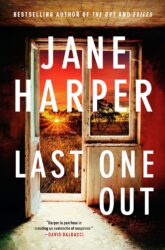 Jane Harper is one of my favorite mystery writers, and her latest novel, Last One Out, shows how tech doesn’t guarantee safety. Carralon Ridge, a once vibrant village in rural New South Wales, has become a shell of itself, its houses and buildings bought up and left to rot by the mining company operating at its borders. The town’s people had initially left in trickles, many stubbornly clinging to land that had been in their family for generations, but years of noise and pollution have resulted in a flood of deserters; only a handful now remain.
Ro expected she would be one of the last people standing, her family determinedly cleaving to the home in which they shared over two decades of memories. However, when her son Sam disappears on his twenty-first birthday while visiting from college, she finds that their shared history suffocates rather than endears, and leaves her husband and home behind, heading to the bright lights and safety of Sydney with her daughter. Five years later, she returns to Carralon, reuniting with her ex and grown daughter to commemorate the anniversary of Sam’s disappearance. It’s an annual event, but this time around, she begins to suspect something was overlooked in his case. The kind of something that just might be worth killing for.
I love that Sam was carrying a laptop and a phone, his image captured by drones, and yet he simply vanished, leaving no easily discoverable clues behind. Technology certainly has made us safer, but it hasn’t resolved ALL our problems.
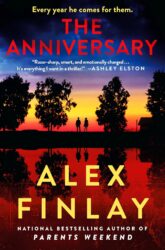 Alex Finlay does a fabulous job of showing how technological advancements can combine with dogged sleuthing to uncover cold cases in his novel The Anniversary. Jules Delaney and Quinn Riley are high school juniors in 1992, with separate plans to attend the same concert on May 1. The selfish actions of one young man at the event send their lives on an unexpected trajectory, entangling them with The May Day Killer and leaving them with scars that will echo through the coming decades.
When the story starts, the characters are all using landlines. Some of the things that happen could have been resolved by cell phones and Uber. But as the tale progresses, and our characters get cell phones and forensics advances, the criminals they chase keep pace with the ever-changing world, becoming adept at avoiding all the things we’d hoped would make them obsolete. This heartfelt, riveting tale will have you reading all through the night.
 Lisa Jewell starts her latest mystery, It Could Have Been Her, with some helpful high-tech. Jane Trevally is walking her dogs on her country estate one May afternoon when a small white pooch appears. Repeated calls for its owner prove fruitless, so she takes the little guy home, gives him a meal, and swings by the vet the next day. The pup does indeed have a microchip implant, and from that, Jane obtains his name (Hugo) as well as the owner’s name and address. A phone call doesn’t yield the results she wishes for, so she finds herself making the hours-long trip to London to reunite the little sweetie with his legal parent. Upon arrival, she discovers she’d been in that house one very dark and frightening night long ago. Meeting with Hugo’s owner proves anything but reassuring, and as additional information surfaces, she realizes she may just have stumbled upon a dangerous mystery.
Jane made a brief appearance in Don’t Let Him In and that experience has given her a taste for resolving real-life puzzles. This is another tale in which technology intermingles seamlessly with sleuthing to deliver an engaging, not-to-be-missed mystery.
 For those whose stories simply can’t work around the tech, try setting them in the past as Kelley Armstrong does in An Ordinary Sort of Evil. The fifth book and eighth publication in her A Rip Through Time series, these volumes star Mallory Mitchell, a twenty-first-century detective who finds herself solving crimes in Victorian Scotland alongside Dr. Duncan Gray, a pioneer in forensic science. Mallory can sometimes be frustrated by her lack of access to the current-day luxuries like CSI labs and CCTV, but it’s fun to watch her and her friends pit their skills and wits against the villains of their stories. This latest installment deals with ghosts, teen girls, gothic poems, and seances. It’s a must-read for anyone who has been enjoying the series (the romance progresses! Hurray!), and I strongly recommend the whole set to those who enjoy clever cozies.
Hopefully, I’ve given readers a good guide to some upcoming mysteries that deal with the technology issue correctly. I could write a long list of those that don’t, but why give bad books good press? How often have you been pulled out of a story by sloppy use of tech? Can you remember books where it just didn’t matter to you, or do you always find yourself bothered by these glitches?
~ Maggie Boyd

Rosie Walsh has a book coming out in May: The One Day You Were My Husband. She uses technology so well–I noticed it in a good way. I think authors are going to lose audiences if they ignore technology. I’ve yet to read a book with AI in it–ignoring that will seem utterly unrealistic going forward. It’s got to be tough.
The story of a woman arrested and imprisoned for six months due to an AI glitch would make a great mystery premise.
Yes it would. I am currently trying to prove my citizenship to the US–I’ve had a passport since birth, was born to two US citizens on a US Army base in Europe. Thus far, it’s not going great.
That might have something to do with the case the Supreme Court is hearing on Wednesday. I was adopted, but my birth parents and adoptive parents were all US citizens. However, they were US citizens living in different places. This want a problem for fifty years but ten years ago new laws were passed and I am suddenly having to deal with all sorts of fun new hopes.
No–mine is a DOGE created problem. They put in AI that is scanning all SS and Medicare requests for fraud and anything that doesn’t fit a traditional US birth is being flagged. And, once you’re flagged, it’s hard to get unflagged. I am now getting help from my Senator. Sigh.
Wow! Sounds tough.
What I find completely distracting and reduces the credibility of whatever they are trying to say is when they get facts wrong. Recently, I finished reading Robert Macfarlane’s Is a River Alive. I only read the section on rivers that run through Chennai, India, because I live in Chennai now and frequently pass by one of the rivers (Cooum) he writes about. He gets one fact wrong and repeats it throughout the chapter—that Cooum river empties into the Indian Ocean. Chennai is a coastal city on the Bay of Bengal and is nowhere near Indian Ocean. (He also repeats the same incorrect info regarding Marina Beach where the annual rescue of Olive Ridley turtle eggs is undertaken.) That had me wondering what else could he have got wrong. His central narrative about the killing of Chennai rivers I agree with. Yet, when he so lyrically and passionately calls a river a living entity and entitled to certain rights (to be free of pollution, for example), I would also argue that it deserves that all the geographic facts about it are also understood correctly.
It drives me crazy when information available on Google is wrong in a non-fiction book. Did no one edit? Did the author not research? I agree that it simply leaves the reader wondering what else is wrong in the volume.
Did no one edit—Macfarlane does say ‘he wrote the book in complete privacy, not in secrecy’. But he is such a big name probably no one dare fact check or edit his work.
I think as a society, we are going to a frightening place where truth matters less to us than aesthetics. I typically don’t watch YouTube rants, but I found this one super interesting.
Like Maggie, I’ve been lucky enough to read some of these before the pub date.
I agree that Finlay and Jewel, in the books she mentions, do an excellent job of incorporating modern technology in these books. Oddly, I found Jewel’s previous book to be utter unbelievable, in part, because she didn’t sanely incorporate modern technology.
I’ve just written up my review–I’ll post it on my substack–of The Anniversary, which comes out on May 12th. One of the things I liked best about it–and I liked it very much–is that as the book moves forward through the years, he subtly charts how technology changes. In particular, the book uses cell phones so well.
Both The Anniversary and It Could Have Been Her have cold cases in them and in both books the cases become easier to solve because of modern technology. It made them both much better reads than, as Maggie points out, the too many tales that fall apart because they ignore the realities of the modern internet and cell phones.
What often surprises me is the type of tech that trips authors up. I don’t understand forensic science much at all, so I wouldn’t even notice if the author sped up the timeline of what police labs can do, or if they had CSI doing things we are not yet capable of. But even a Luddite like me carries a phone and goes online. It pulls people out of a story too much when your characters can’t manage these simple devices.
I so thought that about the last Lisa Jewel book. The basic plot literally fell apart if you thought about cell phones and tracking.
I struggle with the charming man motif in general. Both Adele Park’s Our Beautiful Mess and Claire Mackintosh’s Other People’s Houses had a womanizer as their villain, and I couldn’t imagine falling for him. One of them in particular (Our Beautiful Mess), I would have been likely to have stuck a (metaphorical) knife in. And yet this does happen in real life, too.. . . .
For me, the issue is that these guys aren’t really very charming. So to have women falling for them like a ton of bricks makes the women seem somehow less.
It’s a hard character to write, especially if he is meant to have deceived many people for a long period of time.
I have not read the books that you have found wanting relating to the use of technology to solve mysteries. So, I cannot determine where they fall short. However, I would say this—not everyone uses technology cleverly. It also depends on from which part of the world you do your search and tracking. Having spent some years in India now I have found out that google operates very differently in India. Also, searches and tracking get immediately tailored to who is doing the searching and tracking. Some information will show up on my searches whereas it will not show up when my husband does the same search.
That is true in the US too.
For me, the main issue isn’t even searches because you have to have an idea of what you are searching for for that to work. So I get that going wrong. Or someone not finding what they were looking for, etc. But I don’t get someone owning a phone and not charging it/carrying it. Here in the US (where the book took place), phone service is something you pay for whether you use it or not. Even if you are on one of those pay-by-the-minute phone cards, they only last for a short time (three months, mostly less), so you are just wasting your own money when you leave your phone behind. We also tend to use them for safety. So, a young woman racing about Chicago, like in the book that inspired this blog, just made zero sense to me. Especially since she was angry at her ex for not contacting her when she had NO phone. He could have called the land line where she worked, but who really does that when someone seems to be ghosting you? It’s stalkerish.
One of the reasons I gave up on Ruth Ware after her first couple of books was they featured so much “busyness” about cell phones—who was using whose phone, who was texting, who had service, etc. It was exhausting. Perhaps she’s gotten better at integrating technology and story—but her first few books revolved around getting phone service or not getting phone service to an interminable degree.
I agree that it can be irritating to have mysteries focus on tech, especially since I am no expert in the field. That said, for me, it can be more galling to have a crime that can be solved by a simple device we all carry (phones) and just pretend they don’t exist. Placing the story in a time and place before the phones were everywhere is a simple and easy solution, imo. It’s like the Big Misunderstandings that go on for hundreds of pages when a simple conversation would resolve them. I don’t hold out much hope for an HEA with a couple who can’t communicate the basics.