
20 Years of AAR Top 100 Romances: A Guest Post
20 Years of AAR Top 100 Romances
The AAR Top 100 Romances list has been a go-to source for romance book recommendations for 20+ years. It’s one of the few best-of lists that’s based on reader input, thanks to the thousands of dedicated romance readers (you!!) who have voted on the lists over the years. First launched in 1998, a total of 7 AAR Top 100 Romances lists have been published to date: 1998, 2000, 2004, 2007, 2010, 2013 and 2018.
As someone who is newer to the romance community and eager to learn more about the genre’s history, I love that these snapshots exist—they give us a fascinating glimpse at which books, authors and subgenres AAR readers favored at different points in time. And as I’ve recently discovered, this is data that’s hard to come by.
Recency Bias in Best-of Lists
I’m a romance book data analyst and run a website called Romancing the Data, which includes a directory of top romance books. After analyzing 135+ romance best-of lists for the directory, it’s become clear to me that most lists favour more recent books over older ones.
For example, I researched and published a Best of the Best Romance Books of All Time list last year (October 2024). On that list of 70 books, a whopping 76% were published in the 2000s, even though the modern romance genre started in the early 1970s.
Given this obvious recency bias, I started thinking about how I could analyze older romance books, particularly those published in the late 20th century. Of course, one list came to mind: AAR Top 100 Romances!
Methodology
I decided to analyze the 7 AAR Top 100 lists in order to create a consolidated Top 100 list and see which books have endured on the lists over time. I used a simple ranking system:
- I grouped and ranked the books based on how many lists they appeared on
- Within each group, I ranked the books by their cumulative rank score (determined by adding up their numerical rankings on each list—the lower the score, the better the rank).
If you’re interested in the details of the analysis and ranking, you can view the detailed spreadsheet.
Consolidated AAR Top 100 Romances List (1998-2018)
As if fated by Cupid himself, it turns out there were exactly 100 books that appeared on 3 or more of the past AAR lists! Here is the consolidated list of those 100 books in their ranked order:
- Lord of Scoundrels by Loretta Chase (1995)
- Outlander by Diana Gabaldon (1991)
- Flowers from the Storm by Laura Kinsale (1992)
- Pride and Prejudice by Jane Austen (1813)
- It Had to Be You by Susan Elizabeth Phillips (1994)
- The Bride by Julie Garwood (1989)
- Nobody’s Baby But Mine by Susan Elizabeth Phillips (1997)
- Dreaming of You by Lisa Kleypas (1994)
- MacKenzie’s Mountain by Linda Howard (1989)
- Heaven, Texas by Susan Elizabeth Phillips (1995)
- Naked in Death by J.D. Robb (1995)
- Ravished by Amanda Quick (1992)
- The Secret by Julie Garwood (1992)
- Dream a Little Dream by Susan Elizabeth Phillips (1998)
- The Rake by Mary Jo Putney (1989)
- The Duke and I by Julia Quinn (2000)
- Paradise by Judith McNaught (1991)
- Welcome to Temptation by Jennifer Crusie (2000)
- Devil’s Bride by Stephanie Laurens (1998)
- Dream Man by Linda Howard (1995)
- A Knight in Shining Armour by Jude Deveraux (1989)
- Almost Heaven by Judith McNaught (1989)
- Mr. Perfect by Linda Howard (2000)
- Sea Swept by Nora Roberts (1998)
- Whitney, My Love by Judith McNaught (1985)
- Kiss an Angel by Susan Elizabeth Phillips (1996)
- Devil’s Cub by Georgette Heyer (1932)
- After the Night by Linda Howard (1995)
- The Shadow and the Star by Laura Kinsale (1991)
- Perfect by Judith McNaught (1993)
- Honor’s Splendour by Julie Garwood (1987)
- Bet Me by Jennifer Crusie (2004)
- The Viscount Who Loved Me by Julia Quinn (2000)
- Slightly Dangerous by Mary Balogh (2005)
- A Summer to Remember by Mary Balogh (2003)
- A Kingdom of Dreams by Judith McNaught (1989)
- As You Desire by Connie Brockway (1997)
- Morning Glory by LaVyrle Spencer (1989)
- Jane Eyre by Charlotte Bronte (1847)
- Saving Grace by Julie Garwood (1993)
- Thunder and Roses by Mary Jo Putney (1993)
- Then Came You by Lisa Kleypas (1993)
- To Have and to Hold by Patricia Gaffney (1995)
- Something Wonderful by Judith McNaught (1988)
- More than a Mistress by Mary Balogh (2006)
- My Dearest Enemy by Connie Brockway (1998)
- Once and Always by Judith McNaught (1987)
- Devil in Winter by Lisa Kleypas (2006)
- Romancing Mr. Bridgerton by Julia Quinn (2002)
- Mr. Impossible by Loretta Chase (2005)
- The Raven Prince by Elizabeth Hoyt (2006)
- Lord Perfect by Loretta Chase (2006)
- It Happened One Autumn by Lisa Kleypas (2005)
- Lover Awakened by J.R. Ward (2006)
- Match Me if You Can by Susan Elizabeth Phillips (2005)
- Persuasion by Jane Austen (1818)
- When He Was Wicked by Julia Quinn (2004)
- The Proposition by Judith Ivory (1999)
- Frederica by Georgette Heyer (1965)
- Slave to Sensation by Nalini Singh (2006)
- Born in Fire by Nora Roberts (1994)
- One Perfect Rose by Mary Jo Putney (1997)
- The Prize by Julie Garwood (1991)
- Shattered Rainbows by Mary Jo Putney (1996)
- Ransom by Julie Garwood (1999)
- See Jane Score by Rachel Gibson (2003)
- Born in Ice by Nora Roberts (1995)
- The Windflower by Laura London (1984)
- This Heart of Mine by Susan Elizabeth Phillips (2001)
- Voyager by Diana Gabaldon (1994)
- Where Dreams Begin by Lisa Kleypas (2000)
- Venetia by Georgette Heyer (1956)
- The Secret Pearl by Mary Balogh (2002)
- Son of the Morning by Linda Howard (1997)
- The Madness of Lord Ian Mackenzie by Jennifer Ashley (2009)
- Not Quite a Husband by Sherry Thomas (2009)
- The Spymaster’s Lady by Joanna Bourne (2008)
- Blue-Eyed Devil by Lisa Kleypas (2008)
- Dragonfly in Amber by Diana Gabaldon (1992)
- Dark Lover by J.R. Ward (2005)
- Over the Edge by Suzanne Brockmann (2001)
- Private Arrangements by Sherry Thomas (2008)
- Ain’t She Sweet by Susan Elizabeth Phillips (2004)
- All Through the Night by Connie Brockway (1997)
- Suddenly You by Lisa Kleypas (2001)
- Rising Tides by Nora Roberts (1998)
- Love in the Afternoon by Lisa Kleypas (2010)
- For My Lady’s Heart by Laura Kinsale (1993)
- Castles by Julie Garwood (1993)
- Untie My Heart by Judith Ivory (2002)
- Cry No More by Linda Howard (2003)
- Lady Sophia’s Lover by Lisa Kleypas (2002)
- Open Season by Linda Howard (2001)
- The Duke of Shadows by Meredith Duran (2008)
- Lord Carew’s Bride by Mary Balogh (1995)
- Natural Born Charmer by Susan Elizabeth Phillips (2009)
- A Hunger Like No Other by Kresley Cole (2006)
- The Last Hellion by Loretta Chase (1998)
- The Grand Sophy by Georgette Heyer (1950)
- Sleeping Beauty by Judith Ivory (1998)
You can also check out the Best of AAR Top 100 Romances list I published, which features the top 31 from this list and can be filtered by subgenre, spice level, decade published and representation.
Additional Analysis
Here are some additional insights about the consolidated list.
Century Published
Did this analysis feature more books from the late 20th century? Yes! Here is the breakdown of the list based on century published:
- 1800s: 3%
- 1900s: 58%
- 2000s: 39%
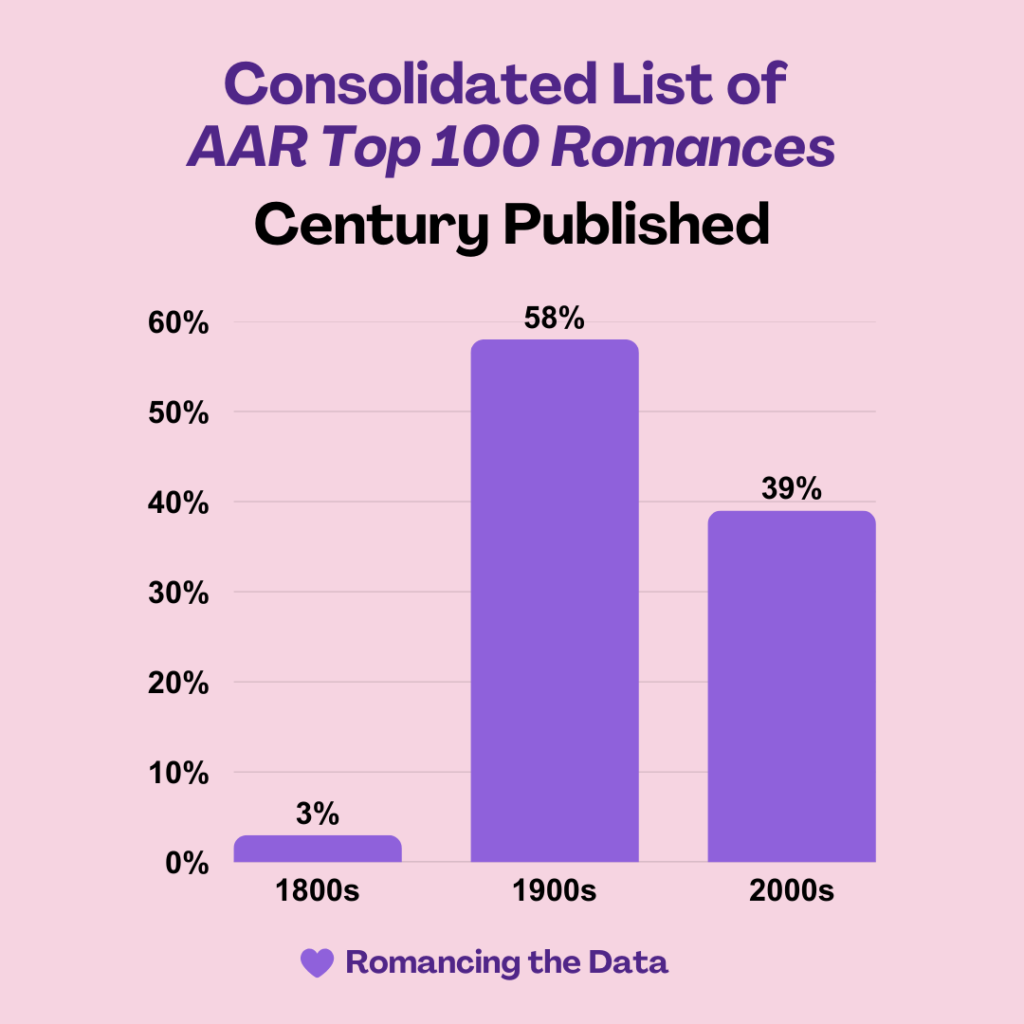
As expected, romance books published in the 20th century are well-represented on the list, making up 58% of the total—the vast majority of which are from the 80s and 90s. Note that the newest book on the list is from 2010 (Love in the Afternoon by Lisa Kleypas).
To compare, only 18% of the books on the Best of the Best Romance Books of All Time list I compiled in October 2024 were published in the 1900s.
Duplicate Authors
Another interesting trend among the AAR Top 100 Romances is how many books by the same authors appear on the list. The consolidated list has 35% unique authors, meaning the 100 books on the list are written by only 35 authors.
These 19 authors all have multiple books on the consolidated list:
- 9 books: Lisa Kleypas, Susan Elizabeth Phillips
- 7 books: Judith McNaught, Julie Garwood, Linda Howard
- 6 books: Laura Kinsale
- 5 books: Mary Balogh
- 4 books: Georgette Heyer, Julia Quinn, Loretta Chase, Mary Jo Putney, Nora Roberts
- 3 books: Connie Brockway, Diana Gabaldon, Judith Ivory
- 2 books: J.R. Ward, Jane Austen, Jennifer Cruise, Sherry Thomas
For the sake of comparison, the Best of the Best Romance Books of All Time list that I published in October 2024 had 89% unique authors (62 authors of 70 books).
Subgenre
Here is the breakdown of the consolidated list by subgenre—as you can see it is dominated by historical romance:
- Historical: 65%
- Contemporary: 20%
- Suspense: 8%
- Paranormal: 4%
- Classic: 3%
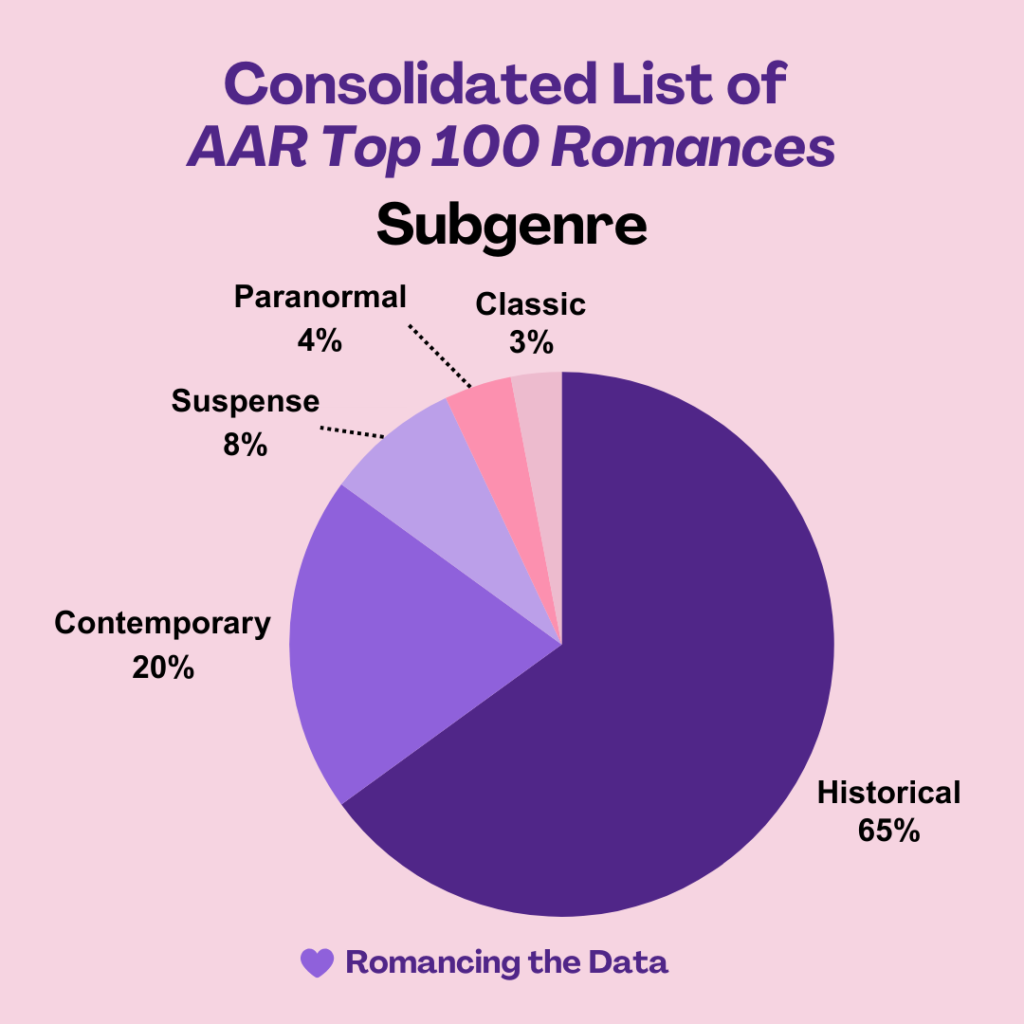
To compare, the Best of the Best Romance Books of All Time list that I published in October 2024 was dominated by contemporary (47%), followed by historical (27%), fantasy/paranormal (13%), classic (7%), young adult (4%) and erotic (2%).
Thanks again to all the readers who voted on, discussed and shared the AAR Top 100 Romances over the past 20+ years!
Lady Jane
I’m Lady Jane of Romancing the Data, a website that combines my love of romance books and spreadsheets with charts, graphs, lists, rankings and more. It also includes a curated directory of the best romance books based on my analysis of 135+ published best-of lists. I’ve been a dedicated romance reader since 2019, reading 150 books a year on average. My favorite subgenres are historical and contemporary (although I often dabble in others!) and my favorite tropes are forced proximity, grumpy/sunshine and dating/sex lessons.

Thanks so much for doing this. It’s such an interesting look at past lists and provides a lovely look down memory lane.
Thanks, Maggie! Glad you enjoyed it :)
I have read every one of these romances (except the one by Robb), which shows you my age. Oddly enough, I started Spencer’s “Morning Glory” about a week ago which has been one of my top-ten romances for decades, but I haven’t read it probably in 15 or 20 years. It still holds up well, but you have to overlook comments about “men’s and women’s work” and other outdated sentiments.
Another reason I have read all of these books is that there were fewer romances around them. My comfort reads are “Mr. Impossible” (which portrays the Egyptians as incompetent, so if that sort of thing annoys you, skip it). One of the funniest and most lovely is “Lord Perfect” which still makes me laugh. But my all-time fav is “Bet Me” by Crusie. It stands the test of time perfectly AND is genuinely funny. If you have or had a weight problem OR you think you are too heavy, this is a wonderful romance. Crusie’s “Welcome to Temptation” is wonderful, too. Like everyone, I like to laugh and both Chase and Crusie do it for me.
I love Lord Perfect-it is hilarious.
Cruise writes a fabulous rom-com. The scenes with/about the water tower in Welcome to Temptation are so, so funny. Her Agnes and the Hitman remains one of my all-time favorites.
I thought I’d read Lord Perfect, but I realize I haven’t. The audiobook is narrated by Kate Reading. I was bummed that my library doesn’t have it on audio since it has so many other Loretta Chase audiobooks, so I’ve put this on my wishlist for Audible.
I love Bet Me. It’s one of Crusie’s books I’ve read multiple times. I didn’t care for Welcome to Temptation when I read it years ago. In fact it took me three tries to get through it. I’m not a fan of using embarrassment for laughs, and I didn’t find anyone to really root for for most of the book except Dilly. I did actually enjoy Faking It, though. I found that very funny with quirky characters worth rooting for. Davy redeems himself!
I like Bet Me but Crusie is usually not for me. Her humor and mine don’t quit align.
That’s fair. Plenty of popular authors don’t work for me. And I’m wary of rereading some older books because I find I’m less tolerant of certain things than I used to be. Last time I reread Bet Me I was so aggravated by Liza for treating Min like a child, going behind her back to warn off Cal. I’d personally be furious if a friend thought they had that right.
As we’ve discussed before, my tolerance for others intervening in the lives of leads is much higher than yours!
I love Bet Me and also wasn’t a huge fan of Welcome to Temptation (but I read it quite a while ago and don’t really remember why!).
I read Welcome to Temptation many years ago and should probably reread to see if it holds up. But I was sold the minute I read Jennifer Kierans review here at AAR. This is how Sophie Dempsey, the heroine, reacts to Phin Tucker, the hero, when she meets him:
“[He] looked like every glossy frat boy in every nerd movie ever made, like every popular town boy who’d ever looked right through her in high school, like every rotten rich kid who’d ever belonged where she hadn’t.”
The review then says “Isn’t that a great description? Do we need to know the color of his eyes after a description like that?” Crusie is such a skilled author that she can leave out those descriptors and still give us a sense of exactly what the hero looks like and how he presents himself to the world (or at least to Sophie, which then serves as an introduction to how she reacts to him).
AAR has had so many INCREDIBLE reviewers over the years. I love that you were hit by Jennifer’s words here!
Morning Glory and Mr. Impossible are both on my TBR! I have a lot of catching up to do :)
When I worked up a list of my own Favorite Books a few years ago (http://www.ccrsdodona.org/markmuse/reading/mostread.html ) I based it on counting rereads in my own reading log, so it had the opposite of a recency bias. I cut the list off at 5 readings, so recent publications (or recent personal discoveries of older books) couldn’t make that cut.
Mark! This list is so impressive! Thank you for sharing. I love seeing others who love tracking their reading as much as I do :)
Thank you so much for this analysis! I read and participate a fair amount in the historical romance subreddit and the recency bias can be frustrating. I also realize that as someone who is probably substantially older than the average redditor, I’m going to have direct experience with books/authors that don’t get remembered or mentioned very much anymore. And while there are younger readers who limit themselves to more recent books because they find the older ones problematic, there are plenty of others who are interested in authors and books they haven’t been exposed to before.Unfortunately, there are only a handful of authors that get mentioned over and over again. It’s great to have this list to refer to and be able to say, these are the books that people love years after they were published.
You’re very welcome, Ruth! I completely agree. I personally have an interest in understanding the history and trends of the genre, but not all readers do. I also like having a reference that lists books from the late 20th century that people still love.
I am in no position to criticize or question how you gathered and analysed your data, Lady Jane. The great thing for me was to go on a lovely trip down Memory Lane and see just how many of the 100 books you listed I have read. And it was lovely to see some of my own Desert Island 10 on the list. Thank you for your efforts and contribution which made interesting reading for me.
Thank you!
Lady Jane is using AAR’s data in interesting ways. I too enjoyed this dive.
Thanks so much, Elaine! I’m so glad you enjoyed the trip down memory lane!! As someone who is newer to romance, these lists are helpful for me to understand the history of the genre!
The methodology makes this only applicable to a small subset of books on multiple AAR Best Of lists. So basically it’s an analysis skewed to older books, since being on more lists gave the books more points. I have no idea what use this kind of analysis is as a comparison, since each book has different criteria for being in this analysis depending on when it was published. This bothers me as a scientist who ran experiments where all the variables had to be accounted for. Here, you really are comparing apples (books published earleir) and oranges (books with no chance of being on multiple lists.)
Each original list is an interesting look at what was popular at that time, and a look over all the lists may show trends, but the criteria here doesn’t actually show what books are more popular to readers, only what books showed up on AAR lists more frequently, which, as has been said, is skewed to assure older books will rank higher.
Hi Carrie! Yes, as mentioned in the post I purposely wanted to favour older books because the majority of best-of lists favour newer books (recency bias). While the methodology definitely has shortcomings, I think it aligns with the stated purpose of seeing which books have endured across the lists over time. I’m sorry to hear that my analysis bothered you. Thanks for reading.
Thank you for your kind response. I get that this is a rather lighthearted look at lists only on AAR. It’s not worrisome here because we’re dealing with a topic that is important to us, but not likely to change how we see the world in general.
The approach (in a broader context) bothers me simply because I’ve seen this kind of analysis done on very important matters with impact on people, on science, and for our country, and that’s scary. When analysts manipulate data to favor an outcome, and people reading it don’t understand that maniplulation, then it has serious consequences including presenting untruths as “facts”, as we are seeing almost daily in the US news.
I’m sorry that my anxiety brain has reacted negatively here, because I do know that this is benign and can be a fun way to look at things.
Thanks for your response, Carrie! Sorry for my delay in responding—I thought I had notifications turned on, but apparently I did not!
I’m glad to hear back from you, as it was certainly not my intention to upset anyone. I completely get where you’re coming from though. Data can absolutely be manipulated to support any desired outcome and it’s scary to think that “facts” and “truth” are losing all meaning these days.
As you said, this is a fun and lighthearted topic, so I felt that stating the bias of the analysis upfront was sufficient. Thanks again!
I find the list of 19 authors listed to be interesting. I’d love to see a comparison of this list of 19, with a list of authors with the most appearances on all AAR Top 100 combined, regardless of title. I wonder if it would be much different – although my guess is probably not.
Also, a breakdown by decade rather than century might be interesting.
I’m somewhat surprised by the lopsided percentage of historical romances to contemporaries (and every other subgenre). I knew HR was far more popular in the AAR lists than CR but three and a half times as much? 3 of the 19 authors are “known” for their CR writing: SEP, Nora Roberts and Jennifer Crusie. I’m not a big Nora reader but neither SEP nor Crusie write particularly “spicy” romances (there’s that word again, Dabney). I’m making a huge assumption here but HR’s – almost by definition – have characters who do not engage in a lot of on-page sex.
Do these lists, either deliberately or subconsciously, avoid titles that contain a lot of on-page sex? And if so, is it because it is so hard to write well (e.g. on-page sex enjoyable in the moment but doesn’t stand the test of time that the AAR Top 100 lists have asked for)? Or have we readers internalized those accusations about romances being just a lot of mommy porn – and so we don’t nominate or vote for titles that might “misrepresent” the genre overall?
I don’t have any evidence for this comment other than my own reading experience, but the older HRs that have traditionally topped the list – Chase, Kleypas, Balogh, Kinsale, Quinn etc. – don’t have as much on page/explicit sex as many of the historicals that have been written in the last 5-10 years.
Given that the newest HR on the list dates from 2010, I suspect that the reason for less on-page sex in the historicals on the lists is simply that the books are older.
Which gives rise to the question – are today’s romances too dependent on sex scenes to draw readers in? I know I’ve written reviews that basically say “this is a string of sex scenes with a little bit of plot in between” or that I’ve skimmed sex scenes in a book because they’re doing nothing to advance the relationship/story. In response to your pondering as to whether the lists either deliberately or subconsciously avoid titles that contain a lot of on-page sex, I wonder if it’s because the older stories are… more cohesive when not constantly interrupted by characters getting it on. I don’t read m/f contemporaries, but I’d venture the same is true of those as it is of historicals – the older books are less dependent on sex to sell them.
Hi! Great questions—I can provide the additional data for you.
Below is the list of authors based on how many times they appeared on the 7 lists (including for the same book over multiple years). As you predicted, it is very similar to the list of 19 authors in the blog post:
Breakdown by decade:
As mentioned, the methodology favours older books as they have more opportunity to appear on more of the lists. I think it’s interesting to see which books have endured over time.
I need to give some thought to your question about historicals and sex on page. If I have a chance, I could do a breakdown by spice level.
Nowadays, I find that historicals are often spicier than contemporaries, unless it’s a darker contemporary.
Thank you for so much great data! I love the list of authors.
You’re very welcome!!
I did a quick analysis of the spice level of the consolidated Top 100 (I couldn’t resist!), using spice ratings of 1-5 from the website romance.io. All the pre-1980s books were rated 1, so I excluded those as they are of a different era.
All the remaining books were rated either a 3 (open door) or 4 (explicit open door). The overall average was 3.33. The average for just historical was also 3.33, while the average for contemporary was actually lower at 3.15. The average for suspense and paranormal were higher at 3.63 and 3.76, respectively.
Another way to break it down:
I personally like a high spice level in my romance books and think a lot of authors write sex scenes very well. There are definitely books that focus more on sex than romance, but I consider those as a different subgenre like erotic romance or erotica.
Hope this helps!
Thanks for the extra digging! One thing I would point out is that the way we rate the heat level in books has changed over the years, as attutudes have changed. Some books which might have been rated “hot” 10-15 years ago, would now get a “warm” rating, A lot of the big-name HR written more recently (by authors like Joanna Shupe, Eva Leigh, Scarlett Peckham etc.) is ‘hotter’, but those haven’t yet made any of our Best of Lists.
Good point! I was listening to a podcast reviewing old issues of the Romantic Times and they had a very different scale for rating the heat level! I did take all the ratings from the same source though (which uses one scale), so the ratings should be comparable despite the age of the books.
Interesting analysis on what romance was popular according to past AAR polls. I’m a data geek so I apologize beforehand if my comments below are boring but my love of data compel me to comment. :-)
The AAR data set skews data to favor older books as older books have a chance of appearing multiple times on AAR lists. For example, a book published in 1992 has the chance of appearing on every AAR list in the data set, whereas a book published in 2018 can appear ONLY on the 2018 AAR list. So it is not surprising that the majority of books in your results are older.
The methodology also favors older books. The description of the methodology states that books were ranked based on how many times they appear on the AAR lists. So instead of attempting to neutralize the bias towards older books in the data set, the methodology gives more weight to the age bias. For example, a book published in 2018 can appear only 1 time in the data set (on the 2018 AAR list) so it can earn a maximum of only 1 point so to speak, which means that books published in 2018 had no chance of appearing on your final list of consolidated top 100 AAR romances as the final list required the book to appear on at least 3 AAR lists.
So again, it is not surprising that the results from this analysis skew towards older books being popular as both the data and methodology favor older books.
I think, too, that people vote from nostalgia. They might vote for an older book that they remember liking when it was first published, but I wonder how many of these likes would hold up after a reread today? Say, if voters were required to reread before voting on an older book.
Your analysis highlights how tough it is to produce a list of top books in any fiction genre.
Thanks for hard work in compiling this.
I think that’s why doing an AAR Top 100 List every five or so years is useful. It does bring new books onto the Best construct.
Hello fellow data nerd! :) Yes, the methodology definitely favours older books (I hope I made this bias clear in my blog post!). After observing a very obvious recency bias in most best-of lists, I specifically wanted to compile a list that focused on/favoured romance books published in the late 20th century. And the AAR Top 100 lists were a great source of data for this. Since the lists are spread over a 20-year time period, we can see which older romance books endured over time.
As you say, there is no perfect way to produce best-of lists. I just think they are a fun way to look at the genre we love and spark interesting discussions!