
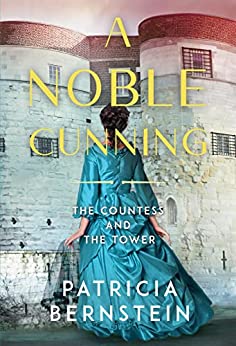
A Noble Cunning
Being an American, my knowledge of Scotland’s historical relationship with England is, sadly, limited to what I’ve gleaned from romance novels, movies and TV programs. Think Mel Gibson’s Braveheart, Liam Neeson’s Rob Roy and, of course, the mother of all Scottish dramas, Outlander. Patricia Bernstein’s A Noble Cunning: The Countess and the Tower does a decent job of simplifying a snippet of this complex history to a relatable level with the story of one woman’s heroic efforts to save her husband from execution after his involvement in a Jacobite uprising gets him thrown into the Tower of London.
It’s 1710 and Bethan Carlisle Glentaggert, Countess of Clarencefield, is happily married to her husband Gavin, and despite their status as Catholics in a land that has gone fully Protestant, they live a comfortable life in the Scottish lowlands with their two – soon to be three – children. One night, while Gavin is away, a mob of religious zealots come pounding on Bethan’s castle door, looking for a priest she’s supposedly hidden on her property. The intruders find nothing, knock Bethan around a bit, and generally demonstrate the danger that Bethan and other Catholics face on a day to day basis.
Flash forward about five years and Gavin has joined a war effort with the goal of overthrowing the newly crowned King’ George I of Hanover (who doesn’t speak English but is acceptably non-Catholic) in favor of the true heir to the English throne, prince James “the Chevalier” Francis Edward Stuart, who currently enjoys the safety of France. Bethan is terrified for Gavin’s safety and, despite her support for returning a Catholic to the throne, would really rather he just stayed home.
Confirming some of Bethan’s worst fears, Gavin is captured by the English and thrown into the Tower of London. He calls for Bethan to come to his aid, and as soon as she can arrange long-term childcare, she and her companion, Lucy, set off. The trip is harrowing to say the least, through horrible winter storms and towns crawling with enemies. She arrives in London just in time for Gavin’s trial, where he is accused and convicted of treason and sentenced to death. When her appeals to the King for mercy go unheard, she takes matters into her own hands, concocting a plot to get Gavin out of the Tower before his execution date.
Based on a real person and a real situation (described in the author’s notes at the end of the book) A Noble Cunning is very readable. The escape plan that Bethan embarks upon is exciting and demonstrates the value of friendship and cooperation and the sheer bad-assery women are capable of when a loved one is in danger. This book would make a very exciting movie, keeping you on the edge of your seat, to be sure.
The exposition of the whos and whens and what-alls of the various royal players populating the era’s chessboard is a bit clunky, dumped in ‘As you know, Bob’ type dialogue between people who would know this stuff and have little reason to spew it out now except as an education for history-ignorant readers like me. Too, sometimes characters’ awareness of certain dangers of their living practices sounds a bit anachronistic. Bethan’s vain sister, Aelwen, explains that she doesn’t use the popular face paints and makeup of the time due to harmful effects from the arsenic and toxic metals they contain. I don’t know if women (and men) were aware of this problem way back in the early eighteenth century..
In the end, I enjoyed A Noble Cunning and did learn something, which, for a book published by a company called History Through Fiction, seems a reasonable expectation. While I can’t say that I’d read it again, I can definitely recommend it to those who enjoy historical fiction.
Recent Comments



Sounds intriguing!
OMG, please totally disregard anything you learned from Braveheart! To call it inaccurate is an understatement…
Y E P Braveheart is suuuper inaccurate all over the place!
As someone who lives in Scotland the myths and grievance perpetrated by Braveheart have been responsible for a lot of the divisiveness in the country in recent years. The type of nationalism it seems to have encouraged is a total scourge. People like me who support the Union are abused and regarded as traitors and Quislings in the country we were born in and love.
You know, I’m kinda glad you’ve said that, because Mr. Caz and I have suspected that to be the case for many years. It’s a shame that such a warped version of history (not to mention MG’s horrible accent!) has almost become accepted truth.
OMG, you are so right about that! Braveheart has Wallace having an affair with Edward II’s French bride who didn’t even arrive in England until three years after Wallace was dead. In any case, it wasn’t anything this proud princess would have dreamed of doing in a million years. I once thought of writing a biography on Isabella of France and was shocked by this historical mishmash! I tried to be so careful in my novel “A Noble Cunning” to portray the facts and the basic structure of the age accurately.
Thankfully, the one main takeaway I got from Braveheart was the horrible method that they used to kill Wallace at the end. Brutal! So when poor Gavin was sentenced to that same style of death in A Noble Cunning, I knew exactly how gruesome that would be. Shudder!