
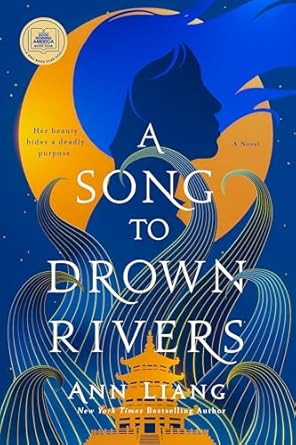
A Song to Drown Rivers
Author Ann Liang tackles the conflict between the Yue and Wu nations in A Song To Drown Rivers, a retelling of the legend of Xi Shi, who is one of the Four Beauties of Ancient China. Like most legends, there are multiple iterations of the tale, with this book mostly sticking to the basic story line.
Xishi is washing silk at the river when a young girl, begging for mercy, collapses in front of her. A Wu soldier is chasing the child with a drawn sword, clearly planning to kill her. Xishi intervenes and expects to die in her place as a result, but the most beautiful man she has ever seen arrives just in time, saving her life. His name is Fanli. Dressed in silks and clearly of the noble class, he nevertheless claims that he is there to see humbly born Xishi. Whispers of her exquisite loveliness have reached as far as the palace, and he, the emperor’s chief advisor, needs just such a woman. There is a plan for vengeance afoot that requires courage as well as charm. Xishi, who lost a sister to Wu violence, is more than happy to be a part of it.
Just like that, her adventure begins. She undergoes thirteen weeks of intense training to become a spy for the Yue. She will be sent as a concubine to the Wu capital, where she is to seduce their young emperor, Fuchai’. Once she has him in her thrall, it will be her task to drive him to do two things: empty the treasury and build a canal that will connect the two kingdoms so the Yue can more easily attack the Wu.
After her short training period, Xishi enters the Wu court with her handmaiden, Zhengdan, a close friend and confidante from the same village who is well-trained in swordsmanship. But it is not easy to gain Fuchai’s attention. He has many concubines, and the battle for his affection is fierce. It is especially difficult for Xishi to seduce this man whom she despises when she already holds her rescuer in her heart.
Several things work well here. The author does a nice job of introducing the conflict between the Wu and the Yue and also showing us how, in reality, the people we think are monsters are often just people who think the same of us. I liked the depiction of the devastation of war; almost everyone we encounter in these pages has lost someone to the fighting. The pacing is brisk, the prose is lovely, and it was refreshing to read a story based on a non-western legend.
There are also some negatives, however. How well you tolerate the flaws in the narrative will depend upon whether or not you are someone who enjoys romantasy. Like most (all?) books in that genre, the court politics here make no sense and problems tend to be resolved far too easily. There is a scene toward the sixty percent mark in the story where Xishi does something that is so stupid I wanted to reach out and smack her. The characters have a lot of modern sensibilities and they are also a bit immature; young/new adults although the positions many of them hold would require someone with greater wisdom and experience. The author fails to create any tension in the story since Xishi is never truly conflicted. In many ways, it is a teen/twenties romp through history.
For some audiences, none of that will be a problem. For others, it will be completely unacceptable. Again, the degree to which you can accept it will all depend on whether or not you enjoy the genre.
There are a few things, though, that the author could have done better, even within the confines of her chosen literary form. One is to have created a real romance between Fanli and Xishi. The two spend almost no time together, and their love is all cryptic comments, stolen moments, hasty kisses, and longing glances. In the legend, Xishi trains for years, and shortening it to months for the sake of the story made it seem almost ridiculous. The court politics should have been handled in more detail and, most importantly, what made Xishi so alluring for Fuchai and why he succumbs so easily to her machinations needed to be addressed more thoroughly. In this tale, Xishi is one pretty girl among many, but she’s meant to be a beauty birds would descend to get a closer look at, and the moon would hide from in shame. Removing that Xianxia (fantasy) element hinders the believabiity of this story. In fact, magic plays almost no role in the tale till the end. Xishi and Fanli have personalities made up of only love and hate: love for each other and hatred for the Wu. More depth is needed to make them something beyond caricatures in a legend. Fuchai makes no sense – he would have been deposed if he were as bad at his job as he is here. Although I would have preferred the author to choose the happier of the two possible endings to the tale, I didn’t grade down for the way the story ends, but I want to warn readers that there isn’t an HEA here. In China, epic romances often have the HEA take place in the next life due to one or the other characters dying within the tale. That happens here, with Xishi and Fanli’s souls reuniting at the very end of the story. This is slightly different from Western romance but conveys a far more epic and timeless feel for the love affair. Still, I wanted to warn those readers who require a traditional HEA of this fact.
I’ve gone with a B as my overall grade for A Song to Drown Rivers because it is a good, if not great, example of romantasy – and because I enjoyed this look at a legend from a different culture. If you like either of those factors, I would recommend it.
Recent Comments




This sounds good! On the pile it goes.