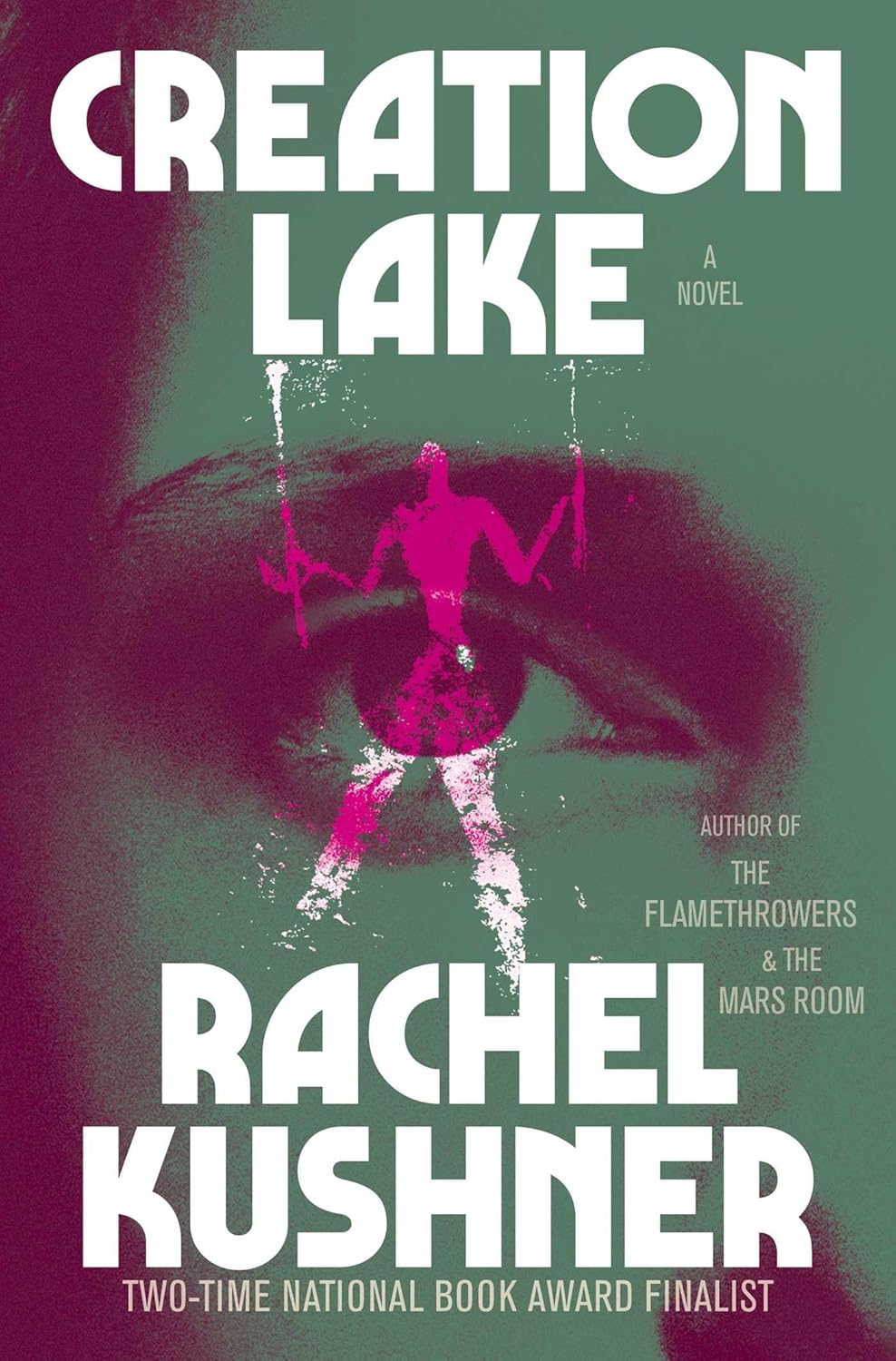
Rachel Kushner’s Creation Lake has been met with rapturous praise. It’s vital and profound, it consolidates Kushner’s status as one of finest novelists working in the English language, and daring, witty, and intensely cerebral.
Nope.
The book is a slog—it’s dense, meandering, routinely pointless, and filled with characters who are, without exception, deeply unlikable. It feels like the kind of book beloved by very serious people, but it’s hard to imagine anyone with a brain and a soul enjoying it. I know I didn’t.
The book begins in rural southern France in the 2010s. Our narrator, currently called Sadie Smith, is a shallow, morally bankrupt spy with breast implants–they are mentioned frequently–and bland good looks who has nothing interesting or kind to say. It’s as if Amy from Gone Girl had a supercilious child with no good reason for her horrible behavior and who has none of her mother’s sense of humor or wit. We know little about Sadie’s background other than she’s a crap human being who was dismissed by the FBI for going too far in a previous mission. She now freelances for scummy private employers which she likes better because there’s less oversight and thus she has more time to drink, sleep around, and sneer at others.
Sadie, for reasons never made clear, is currently tasked with infiltrating a commune that opposes monocrop corn farming and a megabasin, both of which, the commune believes (probably correctly), will damage the land. Sadie is looking for evidence of criminality that, if she can’t find, she’ll create. When she’s not hanging out with the commune–all of whom are equally unappealing–she’s obsessing over a trove of emails from a man named Bruno, one of the original founders of the group
Bruno, who now lives in a cave, has, over the years, sent emails to the commune on topics ranging from Neanderthals to obscure historical groups like the Cagot. (Sadie is unable to find any actual illegal ruminations in his work.) Surprisingly, these digital missives are genuinely interesting, especially when paired with quick Wikipedia searches to fill in the gaps. I’d have enjoyed this book more had it only been lessons from Bruno.
However, much of the novel focuses on Sadie and her efforts to take down the commune which she infiltrates easily. I had a hard time believing this group was capable of much of anything. The men spend their days drinking, hammering on things, and philosophizing, while the women smoke, gossip, and pay little attention to their squalling kids. Kushner presents this dynamic as the “natural order” of things, particularly in France. If I were French, I might be offended.
The book does have brief moments of dark humor and absurdity, but they’re too few and far between. By the time I reached the final pages, I was skimming, hoping against hope that maybe something interesting might occur. It did not. Creation Lake feels less like a book meant to be read and enjoyed, and more like one crafted to spark discussion and win praise in rarified literary circles. Unsurprisingly, it has been long-listed for the National Book Award and short-listed for the Booker.
Art whose sole aim is to remind in the know readers that everything, especially mankind, is awful is art I find dull. If a deeply cynical, chaotic tale with a disregard for humanity’s nuances is your jam, you go. But if not, Creation Lake is a waste of type and your time.




Whenever books like these hammer on about gender roles, my eyes flutter unto the back of my head. Great review, Dabney!
Both the distinction of literary fiction from genre fiction (it’s a genre too, damnit) and the presumed superiority of the former are major pet peeves of mine, so there’s something about reading well-articulated, critical reviews of literary fiction written by proud genre readers that deeply satisfies me, especially the ones that have a sort of Emperor’s New Clothes vibe. This is the best one I’ve read in a long time.
It really irked me.
At one point, for no reason I could discern, Sadie meets a commune member on a public bench and, because he pushes her head down, gives him a blow job.
If this were in genre fiction, it would be decried as sexist and confusing–they’ve never really had a conversation prior. Not great.
A prime example of why I do not read so-called “literary” fiction.
It’s not all bad–but lit fic that the critics all call daring usually is!
THANK YOU! I am halfway through this audiobook and it is such a slog. You just gave me the justification I needed to DNF.
Nothing happens so you won’t miss a thing.
I do think at the end you are supposed to think she might, as some point in the future, not be such a twat, but I didn’t buy it.
Thank you for reading this and sparing the rest of us from the agony.
Any time! Any time!
I have no patience with books like that.
There’s an almost masturbatory quality to them that deeply repels me.
This review almost makes me want to read it . . . but there are a million books on my TBR pile.
I am curious – what makes it a D+ rather than an F?
Kushner can write–much of her prose is strong and her descriptions can be arresting. And I her mind takes the reader to cool places–honestly, I loved learning so much about the Neanderthals and the Cagot. But it’s a trash book in terms of plot, character, and meaning.