
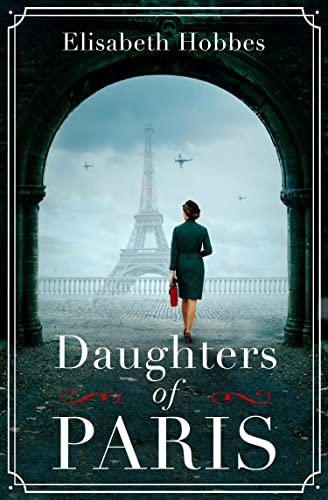
Daughters of Paris
Elisabeth Hobbes’ Daughters of Paris is a story of intrigue, romance, and redemption. I found it to be an enjoyable if somewhat predictable read till the end of the novel, where things took a turn for the worse.
While playing in the yard of the high-end Parisian apartment building in which they live, best friends Fleur and Colette make a delightful discovery: There is a gate, hidden behind an overgrowth of vines and shrubberies. It takes all they have to push the door open and squeeze through but it is worth the effort – beyond that barrier is a small, hidden walled garden with a dilapidated greenhouse full of strawberries. The girls eat their fill and swear to keep the place a secret.
Initially, it is one of many secrets they keep between them, but as they age it isn’t long before they are keeping secrets from each other as well. Colette, the daughter of a wealthy manufacturer, has a life filled with dance clubs, risque friends, endless nights out, and dashing beaus. Fleur, the orphaned niece of the housekeeper, is far more studious. Her friends are students and fellow book enthusiasts who congregate in cafés to discuss politics and reform. Where once Colette and Fleur spent all day talking to each other, their adult selves find they have nothing to say to one another.
And then the unthinkable happens and France is occupied. German soldiers sit at the café tables where Fleur and her friends used to meet. The clubs Colette frequented are now the gathering places of Nazi officers. As their nation is slowly suffocated by the enemy, Fleur and Colette once more find they have something in common – a deep desire to see France free from the fascists who have taken it over.
This novel is pretty much what one expects from a WWII tale. The brash, beautiful Colette has to adjust her life to the occupation, most specifically figuring out how she wants to deal with the invaders. She had been friends with many Germans before the war and while she hates the Nazi takeover of Paris, she also hates the thought of not frequenting her favorite clubs. She finds herself going dancing with the officers of the occupation, uneasy about what she is doing but unable to give her lifestyle up completely. Colette is somewhat selfish and silly at the start but I understood her – she’s essentially a teenager who had been raised to be an ornamental wife. She was in no way prepared for the war.
Fleur, a quiet bookworm with activist friends, quickly gets swept up in the resistance and shows that beneath her calm, sweet exterior is a core of steel. Fleur is by far the more relatable of the two – she has to work for a living, worry about where to live and how to make ends meet, and wonder how she can do her bit for France. I liked how the story shows a young woman who is afraid – she is in no way adventurous or daring – but who sets aside her fear in order to do the right thing. I also appreciated how the story contrasted the two women – one would have expected Colette, with her bold, impulsive personality, to join France’s freedom fight but she is too caught up in herself at the start to do so. She does grow and mature as the fight goes on but it takes her a while for this to happen.
I also appreciated how the author gets the tone of the occupation just right. She depicts beautifully how the French thought life would go on as normal once the fighting stopped and how they quickly learned that wasn’t true. Ms. Hobbes also shows how vindictive people used the new world order to settle old scores, falsely accusing neighbors of crimes just to watch them be hauled away for questioning. I’ve read about this in non-fiction books and it added a real touch of authenticity to see it shown here.
However, there were certain things I did not like. One was the inconsistency with locations – the secret garden seemed to practically disappear halfway through the book, even though the extra food it offered would have been a goldmine during the latter years of the occupation. Fleur initially devotes an apartment she inherits above a bookstore for use by the resistance, but changes that midway through the narrative with nary a thought to how it will affect her friends. Everyone talks too freely about their illicit activities – I understood Ms. Hobbesis using conversation to give us important information but in reality, such loose lips really would have sunk their odds of survival.
Our heroines do fall in love and I liked both heroes. The amorous affairs are introduced later in the book, which is in keeping with the attention given to Colette and Fleur’s friendship. While the romances are important and receive significant page space, the HEAs are not the focus of the story.
My big issue with the tale actually deals with a natural by-product of romantic love – pregnancy. One of our single heroines gets pregnant. When someone recommends an abortion, she slaps them. There is an emphasis on how dangerous abortion is, while childbirth (during wartime with low supplies) is treated as essentially easy and risk-free. I can certainly understand a woman wanting to keep her child and making the decision to do so even during tough times. The fact that this young woman has other options (when many didn’t in those days) and didn’t even entertain them was disconcerting to me though. I became even more uncomfortable when a second young single woman becomes pregnant, this time by a married Nazi officer, and also refuses to give up her child when she has the chance to do so. At that point, it felt that the author was making what in the U.S. would be called a firm pro-life stance. Throw in the conversation about how sorry someone is that they gave a child up for adoption and how they long to get in touch with said youngster, together with the fact that the only pro-abortion person in the text was described as frivolous and selfish and I found myself completely discombobulated. Americans are currently going through a legal battle over abortion rights and this issue has become a pivotal point in numerous elections. I have a feeling this will be a trigger issue for many readers in this part of the world, so I felt I should bring it up despite this topic occurring in the last third of the book.
Daughters of Paris was a fairly enjoyable, typical WWII romance until I encountered the above. I typically don’t give an F simply because a book takes a political stance and I am not going to do that here. However, the subject is handled poorly enough, with no examination from the alternate point of view and no discussion of the very real dangers of a wartime pregnancy, that I felt the book should be downgraded significantly as a result. Hence, what would have been a B/B- read is now a D and I assuredly don’t recommend the novel.
Buy it at: Amazon, Audible or your local independent retailer
Visit our Amazon Storefront
Recent Comments



If anyone wants to read this and see what you think about it, it is on sale today for 0.99.
Wikipedia says:
In 1939, the Penal Code was altered to permit an abortion that would save the pregnant woman’s life. During the German occupation during World War II, the Vichy régime made abortion a capital crime.
So why was it considered an option in this book? That is odd.
And there’s an easy narrative way around it. Abortion was considered a capital crime under Vichy because the Nazi regime wanted more white, blond babies. If the characters had been Jewish it definitely would’ve come up in the conversation, because being pregnant and Jewish in the occupation was dangerous as heck.
Resistance fighters, which one of the girl’s boyfriends is as well as her best friend, weren’t exactly safe either. I couldn’t help wondering if she realized that if the guy was taken, and he was known to be with her, the Germans would haul her in for “questioning” as well.
A good point!
Technically, women have often gone the illegal route to get an abortion so it isn’t outside the realm of possibility that that happened during this era too. The two women who had the option offered to them had wealthy families willing to pay for it and the kind of connections that would have enabled them to find a doctor willing to do it. Instead, both women left those families to keep their babies. One of them not only left but in doing so caused the upheaval of an apartment used by the resistance to harbor people fleeing France. And lost herself and others’ access to a food source at a time when the French were for all intents and purposes being starved by their captors.
I linked to an article about an illegal WWII abortion provider below but here it is again for those that missed it. https://historycollection.com/last-woman-guillotined-world-war-ii-concentration-camp-survivor-lead-legalization-abortion-france/
Yep, people have been having abortions since time immaterial.
I’m wondering if a pro-life reviewer would have the same problems. To me, if a book is hectoring and the politics detract from the story, a lower grade is warranted. If it’s a stance I don’t share but it’s accurately portrayed, I’m not sure I’d lower the grade.
The problem for me was that the author brought the issue up. Repeatedly. And every time it was made clear that the right choice was not an abortion, regardless of the circumstances. It bothered me because it would have been easy enough to simply not have it be an option. Healthcare, much less this kind of specialized health care, was not easy to obtain in occupied France. So a dismissal out of hand, a simple thought by the heroine that finding a doctor to abort would be too difficult and too dangerous, would have been more appropriate than what occurred here. Moreover, it wasn’t a case of “I want this baby” – one of the women actually plans on giving the baby up and doesn’t name it for weeks.
I give good grades to people with opposite political stances than mine all the time. But I don’t like when those stances are needlessly inserted into the text. Just my .02 but I felt this was clumsily handled.
I support you!
Thanks :-) I think I didn’t do a good job of explaining just why it got under my skin in this particular instance. I don’t mind a differing viewpoint but I do mind when a complicated issue is presented simplistically. I don’t think I explained well how that happened here and for that I am sorry.
Didn’t the reviewer take in account that the author writes about women raised in the first half of the 20th century, where even in secular France education especially for women was in the hands of the catholic church?
Must we always measure the past according to our believes? Today’s trigger points weren’t the ones of the 1940ies.
The book is written for today’s readers, so as a reviewer it is my job to keep what could trigger them in mind. I did seem to do a bad job of clarifying what I was trying to say, so I’ll give rewording it a whirl. I would not have imagined that obtaining an abortion in the middle of war during the 1940s was an option. I was surprised when it was brought up, not once but twice. Once that option was put out there by the author, I felt I had to deal with it. Would a woman able to terminate a baby she didn’t want, facing a hard delivery due to the occupation, kicked out of her home by her family, and knowing that her link to the resistance meant she could be imprisoned, tortured, and/or killed at any moment reject the chance to abort so vehemently? Would another woman also kicked out of her home and completely impoverished as a result, giving birth to a Nazi officer’s child, and knowing both that the war was going badly for the Germans at that point and how the French people treated collaborators really want to keep that baby if this option had been offered as an alternative? This is what disturbed me. That the choice was pointed out by the author. That it was made available to the women and then they rejected it. To me, it contained a message – that no matter how bad your circumstances or how difficult raising the child would be, you should still have the baby. I’ve read lots of WWII novels, and most of them handle the issues around an unplanned baby a lot better.
I think I’ll have to read the book to learn more about the women in question. Abortion was an option in war times, more so than in peace times, illegal but nontheless. And very dangerous, often more so than childbirth. But mostly the decision depended on the character of the woman and her education – just like today.
Respectfully, according to the vast majority of research out there, it tends to be economics and circumstances, not character and education, which drive the issue, whether historically or in the modern day. And again, the subject could easily have simply been avoided. The author made it a point in her book, so I had to make it one in my review.
This is an interesting article. I think all classes, religions, and kinds of women have gotten abortions throughout history.
https://publishing.cdlib.org/ucpressebooks/view?docId=ft967nb5z5&chunk.id=d0e373&toc.depth=1&toc.id=&brand=ucpress;query=russia#1
Wow, this is the lowest we’ve ever gone on a Hobbes. The way abortion seems to be portrayed here would’ve caused me to drop the book; French women were delivering babies literally underground during bombardments, there were illnesses and diseases, and all of this for those who weren’t forced through the horrors of camp life! I am yikesing at a character having a Nazi’s baby in particular.
I do have a question – are either of the characters here Jewish?
No, neither character is Jewish. What was strange to me wasn’t the women having babies but that they had a choice, a big deal was made about them having a choice and they made this decision. Most women during that time wouldn’t even think they had a choice. I honestly wouldn’t have considered abortion as an option if the text itself hadn’t brought it up. Given the time period, I would have assumed it wasn’t a possibility – which is why the whole thing struck me as strange.
Mmm, that adds another troubling layer on to the narrative, because we know what’s happening to pregnant Jewish women all over Europe (see the story of Gisella Perl, a doctor who performed a number of abortions in Auschwitz so that the pregnant people in the camps had a fighting chance of survival)
This is an interesting article on how a WWII abortion provider was guillotined in France (1943) and a WWII holocaust survivor led the fight for abortion rights in the 60s and 70s in that country.
https://historycollection.com/last-woman-guillotined-world-war-ii-concentration-camp-survivor-lead-legalization-abortion-france/
This I didn’t know about – that’s fascinating thank you for the link!
I was a bit freaked out by the use of the guillotine. I figured that had gone out with the French Revolution but clearly, I was wrong.
The number of ways people were murdered in the holocaust is horrifying to behold.
In France the last execution performed by Guillotine took place in 1977! Nothing to do with the holocaust.
You might want to address your comment to Maggie versus me, since we’re talking about two different subjects!
Jou are right. Sorry!
pm
In France the last execution performed by Guillotine took place in 1977! Nothing to do with the holocaust.
I didn’t associate the holocaust with the guillotine but with the French revolution, where it was very much in use. I was just surprised that it continued to be used after that event by the French government because I figured more efficient methods would have been found. Clearly, I was wrong :-)
I too found that fascinating.