
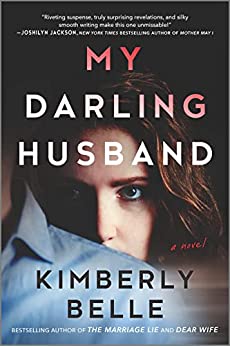
My Darling Husband
Jade Lasky knows she’s in danger. She has seen the guy with the scarred face and man bun far too often for it to be a coincidence. But when she calls her husband Cam to report her concerns, he is dismissive. Atlanta might not be a small town but Jade is a stay-at-home mom who follows the same routine every school day. It is likely that this man is on a similar schedule and that is why she bumps into him so often.
Cam doesn’t mean to be dismissive of Jade but he has his own set of (seemingly) much bigger problems. A popular celebrity chef, he’s opened a series of restaurants that had him dubbed Atlanta’s Steak King, but he’s drowning in debt and now the only one of his eateries that is an actual money maker – the crown jewel of his collection – has been destroyed in a terrible fire. Cam hasn’t told Jade just how deep in trouble he is and his only hope is if the insurance company comes through quickly with a check (Clearly he’s never had an insurance claim before).
When Jade pulls into the garage at home with the Bees (the cute nickname she and Cam have given their children Baxter (six) and Beatrix (nine)), she is already stressed about the evening. She’s worried she’s being stalked. Beatrix, a violin virtuoso who’s been taking expensive private lessons, wants to switch instruments. Baxter’s a tad crabby. It looks like it’s going to be a rough night.
She’s right because waiting for Jade in the shadows beside her usual parking spot is a masked man with a gun and a very specific plan. Jade, the intruder and the kids are going to wait for Cam to bring home $734,296.00. Cam has only hours to do this – or things will go very, very badly for the frightened mom and her two little kids.
My Darling Husband has numerous strong points. One is the pacing. The author moves her plot along briskly and rather than a monotonous but terrifying scenario of the four people in the house watching a clock tick down, we get non-stop action as Jade and her daughter Beatrix work on outwitting the home invader and Cam races around town trying to get the cash.
Cam and Jade are amazingly sympathetic. I expected superficial rich celebrities or the usual (for the current market) villainous victims, but that is not the case here. We meet two people who have worked incredibly hard for what they have and are surprisingly ordinary in how they conduct their lives. Jade might have a fancier house than most people but she does a lot of the cooking and cleaning herself and is a practical, down to earth, hands-on mom. She is terrified for her kids and immerses herself in creating a best-case scenario out of the nightmare she finds herself in.
Cam may have made a lot (and I mean a LOT) of poor business decisions but he is a loving husband and father who is willing to put everything on the line to save his family. He’s a bit brash, not what anyone would call a long-term thinker and he can be cold and callous when it comes to how he conducts commerce, but he always takes his wife’s calls, he looks after his mom and is kind to her even when he is stressed, and he makes time to talk to his kids even on his worst days. He’s a flawed but likable human being.
I would say this book is a lot like Cam – enjoyable but with some imperfections that keep it from being great. Fortunately, most of those faults don’t show up till near the end of the novel and they are almost entirely about believability issues. Cam, a businessman, is apparently clueless about how insurance works; in fact, all of the characters behave in a manner that shows they have no inkling of how insurance payouts are actually handled. I’m far from being an expert, but even I understand that some of what these folks believe borders on the ridiculous. There also seemed to be a basic misunderstanding about what being an accomplice to a crime would mean and no acknowledgement made of the fact that in Georgia, home invasions are treated as a federal offense. The aftermath of the event certainly doesn’t account for those factors. Beatrix is presented from the start as an extraordinary child, bright and capable beyond her years but since we spend only a few short hours with her, her exceptonalism seems mythical rather than authentic. As she becomes a more pivotal character in the story, I found myself believing less and less about it.
I think I was meant to find the home invader sympathetic due to what had inspired him to act – but I did not. He absolves himself of the truly foolish choices he has made, concocts a ridiculous scheme to solve the consequences of those actions, and terriorizes a woman and two young children to see that unlikely- to- work scheme come to fruition. In real life, his plan would have been more likely to backfire than succeed and only the magic of fiction gives his scheme any credence.
While I can’t go into details, I do agree with the author’s overriding point that in a just society, the villain’s problem wouldn’t have existed.
My Darling Husband is an adrenaltin rush of a book, a summer action blockbuster style novel – entertaining while it lasts, but not something that stands up to deep scrutiny. You are so engaged throughout though, that the flaws don’t really detract from the tale till you set it down. I would recommend it to fans looking for thrills (action) over chills (mystery).
Buy it at Amazon, Audible or your local independent retailer
Visit our Amazon Storefront
Recent Comments


Finished this last night in one go. Definitely was hard to put down. After reading the review and everyone’s comments, that didn’t stop me from turning the pages. And yes Cam should have known about the financial stuff, but he was in a panic to save his family so I could understand his actions re trying to get insurance money ASAP. The kids were the stars of the show.
For those interested, here is a spoiler of what the societal problem in the book is. Serious spoilers ahead.
Without spoiling your spoiler, I’ll just say that even if the character had the things they’re lacking, there’s no guarantee that there would be a positive outcome for their specific situation (although, I agree, it would certainly increase the odds in their favor). Making that particular situation the motivation seems like a poor choice on the author’s part.
I’ve seen it used before and it is always difficult for me. On the one hand, I totally agree that what the character needed should be available to all. Full Stop. On the other, terrorizing a woman and her children isn’t the way to go about getting it.
So he’s kind of like the
There was also a recent episode of 9-1-1
Yep, that’s what it was basically like. I found him unsympathetic but agreed with the basic ethical point being made.
That occurred to me as well. And I thought the plot would have been stronger if the author had emphasized that more – that this was a third world problem in a country determined to see itself as #1 in the so called First World. It’s a complex point and the book had too much going on to deal with the issue with the nuance and thoroughness needed. And the fact that simply everybody in the book had no clue how insurance worked was a real problem.
And from a purely technical/commercial point of view, it kind of excludes a large proportion of the reading public from being able to relate to your book! Of course I’ve read books where characters have to deal with medical bills – it’s impossible not to read them given the vast majority of stories are set in the US – and that’s fine (if a completely alien concept!) but a book where it’s basically the entire premise is very hard to accept.
While I can’t go into details, I do agree with the author’s overriding point that in a just society, the villain’s problem wouldn’t have existed.
Mmm, I dunno. I think I’ll give this one a miss. Blaming your evil actions on society is not an excuse I’m willing to accept. If you think about it, that’s the excuse the IRA bombers used, it’s the excuse the 9/11 guys used—heck, it’s the excuse Al Capone used. Everybody can use that excuse in one form or another. I’m not buying it.
It reminds me of the end of a Monty Python skit: as the culprit is being arrested, he says, “It’s a fair cop, but society’s to blame,” to which the arresting officer responds, “Alright—we’ll arrest them instead.”
I think in this particular case society really is to blame. That doesn’t excuse the villain’s actions – I mention in my review I found him unsympathetic – but there was definite injustice at play which the author rightfully pointed out.
I think everyone makes choices and needs to take responsibility for those choices, but I also understand that it’s a cop-out for Society to rely solely on individual responsibility. Poor health care, bad schools, pollution that mostly affects neighborhoods of POC — these have consequences that Society needs to address so that the options open to individuals lead to good choices rather than negative ones (for themselves and Society as a whole).
Susan, that is the author’s point as well. As I stated in my review, I felt that the villain “absolves himself of the truly foolish choices he has made, concocts a ridiculous scheme to solve the consequences of those actions, and terrorizes a woman and two young children to see that unlikely- to- work scheme come to fruition.” and that I found him unsympathetic as a result. However, his foolish choices were going to exact an extremely unfair price because we don’t live in a just society. I found his choices appalling – but his reason for making them was horrifying.
I don’t disagree with you at all. The point I was making was that we all participate in Society and so can’t ignore how our seemingly innocent choices flow out into the larger world. I’ve not read the book, so perhaps that is the point both you and the author were making – I don’t know
I think we are on the same page re the idea of individual choices and how they play out into the larger world. I’m trying hard to avoid spoilers in my posts, so I think some of our agreement is being lost in my obscurity :-) Really, though, the issue in this particular book is the author tried to deal with a complex reality in a simplistic (and rather stupid) manner. Her point was good but all the hoopla she put around it rather ruined it.
I mentioned in my review that I found the villain unsympathetic. He “absolves himself of the truly foolish choices he has made, concocts a ridiculous scheme to solve the consequences of those actions, and terrorizes a woman and two young children to see that unlikely- to- work scheme come to fruition.” That said, I found the situation he was in appalling. He was fighting for the life of a loved one and in a fair society, we don’t have to fight for ourselves and our loved ones to survive.