
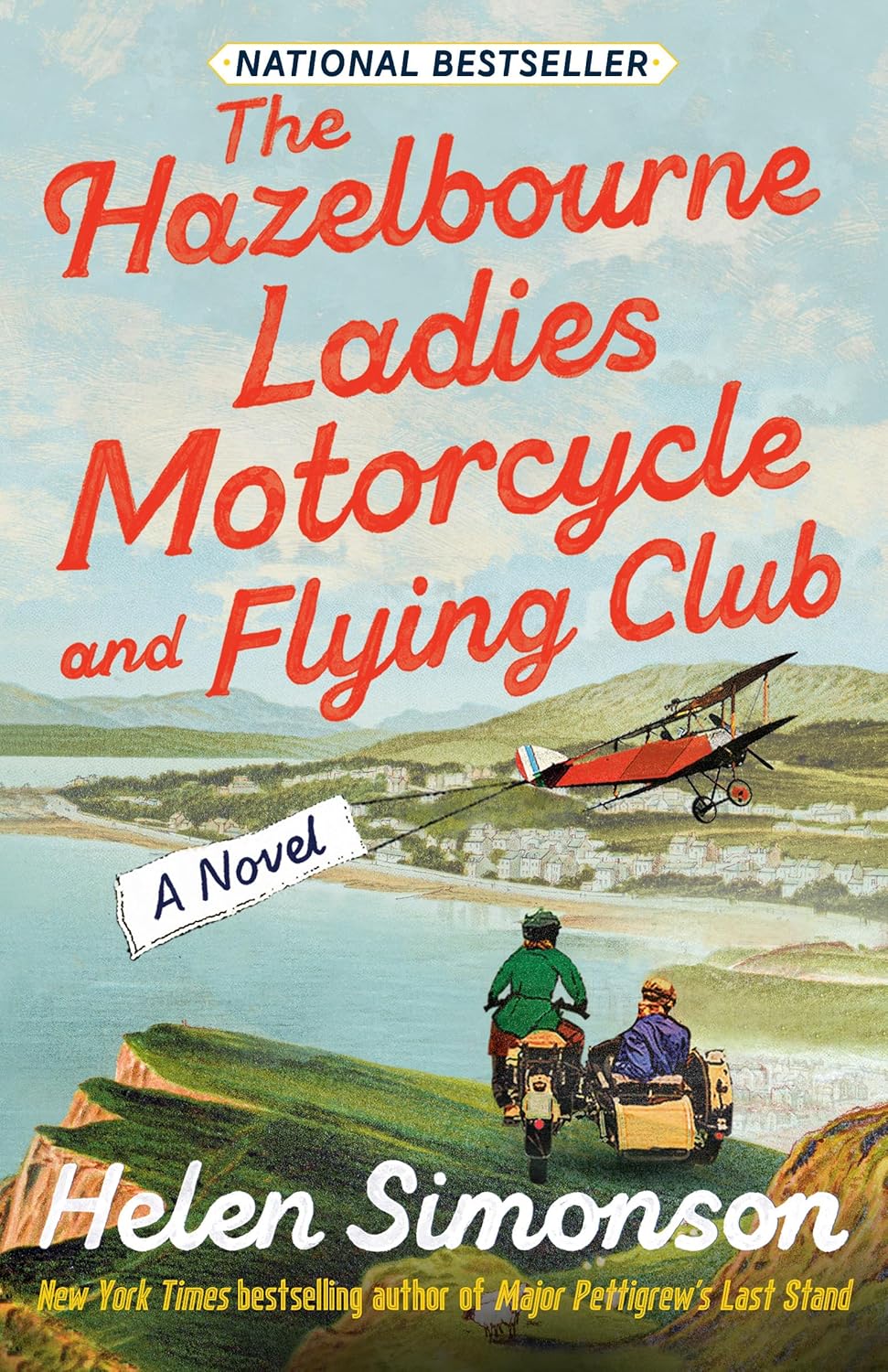
The Hazelbourne Ladies Motorcycle and Flying Club
The Hazelbourne Ladies Motorcycle and Flying Club is a well-researched, charming look at a bygone era.
1919 is a year of mixed emotions for most people. While the war and flu epidemic have finally passed, leaving joy in their wake, the loss of loved ones to these events has been devastating. Almost no household has escaped the consequences, and Constance Haverhill is amongst the walking wounded. She lost her mother and nephew to the recent illness and is additionally facing unemployment and homelessness. The men have returned from battle, and the jobs single women were using to earn enough to keep a roof over their heads are being taken from them and given to the returning soldiers. The ladies are told to find husbands.
Constance is steadfastly looking for a position. While she conducts her job hunt, she works diligently as a lady’s companion to the mother of an old family friend, Mrs. Fog, who was saved from becoming another victim of the flu by Constance’s devoted nursing. This time spent at a lovely seaside resort while Mrs. Fog is convalescing comes with paid room and board and is meant to recompense Constance’s dedicated service. With her patient still quite fragile from her recent illness, Constance often spends the time her charge is resting quietly exploring the lobbies and terraces of the hotel, which is how she comes to rescue Poppy Wirrall from a social faux pas. Or more specifically, from displaying a horrible lack of decorum by being a single lady attempting to eat in a public dining room by herself. It has the hotel staff and other guests in a complete kerfuffle.
Constance joins Poppy for the meal, making things marginally proper once more. While the women share tea and life stories, they surprisingly become fast friends. The practical, pretty, soft-spoken, and humbly-born Constance is the perfect counterpart to baronet’s daughter Poppy, who wears trousers, operates a taxi and delivery service to employ local women, and runs a ladies’ motorcycle club (to which she plans to add flying lessons). Poppy, her brother Harris, and her mother are living in the hotel while their country home is being refurbished. The two women enthusiastically welcome Constance into their family, and while Harris, a former fighter pilot who lost his leg in the war, can be sarcastic, self-pitying, and coldly superior by turns, even he slowly thaws in Constance’s presence.
Constance’s time at the shore is limited, though, and the moment is rapidly approaching when she will have to leave Hazelbourne-on-Sea for the working world. Yet her new friends are reluctant to let her go, and she is equally reluctant to leave them. Is it possible for her to stay and build a new life among those she’s come to love?
On the surface, this tale is a saccharine-coated look at life in an idyllic English seaside town, but woven into all that sweetness is a strong perusal of the small injustices of life and how they can be quite large to the people they affect. One subject explored in depth is women’s rights. Constance, Poppy, and the ladies of the motorcycle club all did meaningful work during the war. Constance’s intelligence and assiduousness as an estate agent led to the Mercer family properties thriving, but once the war was over, her post was given to a man, and she was stripped of her home and livelihood in one blow. Poppy worked as a courier and her courage and tenacity were lauded by many, but society expects her to give up her thrill-seeking ways to marry well. Her friends find themselves in a similar position as new laws begin to severely limit the jobs women can hold.
Sexism isn’t the only -ism tackled in this novel. Harris and many of his fellow returning wounded soldiers face a great deal of ableism. Harris used to fly at a friend’s airfield but is not allowed to anymore because of his missing leg, even though the prosthetic he wears functions adequately for his piloting needs. He is denied a position at the bank, a spot which had been held for him during the war, because the public doesn’t want to look upon the wounded. Harris is rightly furious since his feet would be hidden under the desk most of the time, and his prosthetic ensures he has only a mild limp. Many men in far greater need find themselves in the same boat. Even the mildest deformities are considered reminders of the conflict’s cost, which must be hidden away so the public can “move on”. Society’s hypocrisy on the issue – with the soldiers lauded as heroes and jobs stripped from the women while the wounded are simultaneously rejected and shunted to dark corners – is shown in all its horrific glory here.
We also get a close look at racism and elitism through Mrs. Fog’s family who disapprove of anyone not of their class or color.
The characters occasionally come close to drowning under the weight of all the points they are making, but Ms. Simonson is a good enough writer that they are able to rise up to the challenge. I found myself deeply invested in the story as our leads slowly go about their lives, building relationships and coming to realizations about who and what matters most to them. Constance and Poppy, being compassionate and clever, do this with more ease than Harris, who still struggles with clinging to the old rather than embracing the new. It takes almost the entire book for him to come to the understanding that he has to release what was in order to live in the now, and that journey wouldn’t have been possible without our two ladies giving him heaping helpings of aid along the way.
There is a romance here, but it is extremely subtle and slow-burn. The HEA literally occurs on the last page.
What keeps the book from a higher grade doesn’t occur until the 80% mark. At that point, a character we’ve grown quite attached to is shown to have feet of clay, a man who was irritating but not villainous turns out to be a complete reprobate, and a very sweet, fragile secondary character becomes a sacrificial lamb for no good reason. It’s obvious the author is trying to add last-minute conflict and drama, but it’s a completely unnecessary addition that sets up awkward situations for the future our heroines face.
The Hazelbourne Ladies Motorcycle and Flying Club won’t be a good fit for every reader. It’s long, and those tired of social issues may find too much of that here, and the romance is sparse. However, I think fans who enjoy ‘comedy of manners’ style books will be completely delighted by this novel. I am happy to recommend it to them.
Recent Comments




This sounds like a must read for me. I love reading historical books and don’t mind reading about the injustices that occurred; we need to learn from our past so we do better in the future.
Hope you love it.
I enjoyed the story a lot more than you did Maggie. I felt so frustrated for the women characters but they did the best they could possibly do in that time period.
They did do their best, which I really appreciated. I’m glad you enjoyed it.
This sounds so charming!
It is very charming, and I think the history in it is lovely.
Your review is so thoughtful! I have been wanting to talk about this book since I finished it. My grade was a little higher – I really loved seeing how strong the women in the story were as they adjusted to all of the changes after the war and flu. I think it would be great for book club. Thank you for your review!
There were some moments at the end revolving around the submarine and its’ “Captain” that kept it from a higher grade. I really struggled to see the purpose behind that fiasco and felt it left one of our heroines looking rather bad.Without that it would definitely have been an A-/B+
Sounds like a nice diversion Maggie, and a good reminder about what those “good old days” were really like. Thanks for reviewing it!
The history here is incredibly well done. If you enjoy historicals from that time period, it’s a must-read.