
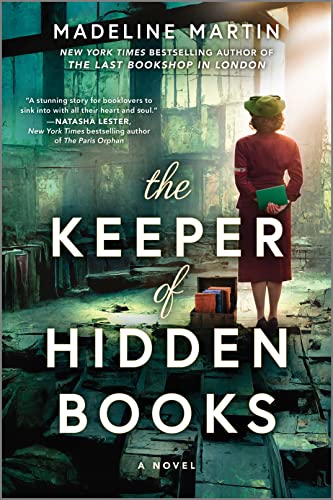
The Keeper of Hidden Books
Madeline Martin gives us another look at how bibliophiles fared in the conflicts of WWII in her latest novel, The Keeper of Hidden Books. A view of love, loss, and occupation, this stellar story will have you appreciating the freedom and peace you enjoy and realizing just what it costs to have it.
It is August of 1939, and Zofia and her friends, Janina and Maria, are basking in the enjoyment of being young and free. All three belong to the Girl Guides, excel at school, and are busy planning for their future once their education is finished. When the fighting with Germany begins, none of them expect Poland to fall. And nothing in their lives has prepared them for the relentless bombing, for pilots that smile as they strafe city streets with deadly bullets, for the losses of friends and family as the fighting wears on and on.
Books are both their escape and a subtle form of resistance. Even before the war with Germany began, the young ladies had formed the Anti-Hitler Book Club, determinedly making their way through all the volumes the Nazi dictator had banned, and as the fighting rages around them, they resolve to read even more of these stories. When they see a bombed library, its books scattered amidst the rubble, they join in rescuing what they can from the destruction. Helping to find the books new homes and aiding in running the main branch of the Warsaw public library quickly becomes a way of life for them, along with short food rations, power outages, and daily air raids. But even that is insufficient preparation for the occupation – and the appalling cruelty of those who now run their country.
Zofia and Janina become official library employees once the Nazis take over but Janina, who is Jewish, soon finds herself facing intense persecution. In spite of that, both girls insist on expanding their book club to include kindred spirits and on doing what little they can to thwart the new regime. As the persecution and danger rise, will their courage be able to face the challenge? Or will they, like so many others, learn to accept the status quo?
Those looking for a book-centric story will need to look elsewhere. Novels are lauded as a wonderful escape from the horrors they are experiencing but the focus of this narrative is on the persecution of the Polish people, especially anyone of Jewish descent. While Zofia does take on the dangerous task of hiding books the Nazis ban, that work makes up less than ten percent of the tale. Mostly, the author fixates on the atrocities of the occupation and the cost paid by almost everyone who resisted. From the librarians who were caught and murdered while moving forbidden manuscripts to safety, to those killed for being old, slow, Jewish, or simply in the wrong place at the wrong time, the death toll is staggering. Both Janina and Zofia concentrate almost all their efforts on saving people from the ghetto, even as that inevitably costs them more than they could have imagined.
The characterization of the two leads is hard to pinpoint since so much of the text is given to action and worry. Both Janina and Zofia are so driven and focused that their personalities are subsumed by the things they are doing and their desire to succeed. Of course, what they are doing is very admirable and it is understandable that they are driven towards success when the result of failure would be their own deaths and likely that of anyone in any way associated with them, but many stories of this nature still take time to build more of an identity into their principals than this one does. At one point, a character mentions once wanting to be a museum-worthy artist; when asked why he no longer has that dream, he says, “Who would waste a dream on something so selfish?” That sums up, I think, what is wrong with the story – the characters have nothing left in them but their present circumstances. With the exception of knowing that Janina is beautiful and that Zofia once wanted to be a writer, who they are as people is completely engulfed by what is happening. Even important issues, such as why Zofia had a strained relationship with her mother from the start or why her father was so prescient, really needed more/deeper exploration.
Fortunately, there are some incredible secondary characters here. Maria, who impacts both the start and ending of the novel; Darek, a young man with a love for reading and freedom who goes to amazing lengths to both save books and help those most endangered by the occupation; Krystyna the Girl Guide leader whose depth of character, intelligence, and courage left me in awe; Kasia and her close friend Danuta, both of whom are ardent readers and courageous young women. We don’t get to know them any better than the leads but that (mostly) works, given the roles they play within the text.
There is a romance here, but it happens towards the very end of the book, takes up less than five percent of the storyline, and is really a pale shadow of the relationship between Janina and Zofia. The focus of the tale is more on friendship than romantic love.
Something the author does exceptionally well is showing how thoroughly and unequivocally resisters were punished – entire apartment buildings of people were killed if just one family was caught dissenting. Minor infractions – such as taking a banned book home, owning a radio, or talking to someone through the ghetto wall – could all be punished by death. There was a suffocating presence of German soldiers on what felt like every street corner and people turned in neighbors, not because they were hateful collaborators, but in an effort to save their own children. As Zofia says at one point, “There was no right way to respond – to sacrifice a loved one and yourself, to whom others looked upon for help, or to intervene for those who saved others and be arrested as well in the process (meant) your sacrifice would be for naught.” Ms. Martin does an outstanding job of capturing just what it means when tyrants are in charge and how that actually looks for the folks suffering under their rule. It has the added benefit of highlighting just how much courage and perseverance it took for those who did resist.
That said, the author’s talent for making the reader really feel the cost of the occupation makes The Keeper of Hidden Books a tough story to enjoy. It’s a novel I’m glad to have read, and one that serves as a reminder of important history, but it wasn’t joyous or fun to read. I would recommend it to everyone, but I would also recommend choosing a moment when you’re ready to experience some angst and heartache.
Recent Comments



I’ve gotten terribly picky about my WWII HF because they’re so very, very much of it. Will give this one a try!
Thanks for the review Maggie. It sets appropriate expectations and sounds a lot like the author’s The Librarian Spy, also set during WWII in Lisbon and Paris. (Light on library work and light on romance but important historical fiction about what life was like for ordinary people in the midst of the war.) I mostly enjoyed The Librarian Spy and wish I were up for another like it because the Polish setting would be new to me. But it may be a while before I’m ready for what is clearly going to be a dark story.
I found The Librarian Spy a lot lighter than this tale, and let’s just say I liked the romance a lot more in that story. Glad you liked the review and I hope you can pick this story up in a moment when you’re ready for some angst.
Good to know! The Librarian Spy was about as dark as I want to go right now, and I thought the romance in that was almost non-existent. There was a time in my life when I’d have read this enthusiastically, but now . . . I’m not sure this will ever appeal. But for sure not now. OTOH, my mother will probably love it. Thanks! I’ll recommend it to her.
Glad the clarification helped, and I hope your mom likes the book. :-)
Knowing that entire families could be killed for what another family was doing puts into new perspective why people would betray their neighbors or rat them out, why the fact that one person helped hide a Jew could be seen by others as selfish even since it would be putting people at risk who have nothing to do with it and who have not accepted the same risk freely at their will.
Simply neither option seems right if you help you are endangering other people not just your own life if you don’t help you turn a blind eye as the regime intended.
I was grateful to the author for highlighting the genuine danger of resistance fighters and how that peril was actually shared by the whole community. When you shoot a Gestapo officer, and the result is 50 random villagers are killed, it shows just how high the stakes are for the entire community. I think this is important history to share since so many seem to be forgetting it.
That threat is the secret to most of history’s most oppressive, horrific governments. Stalin and Mao were masters of it as were Southern slave owners.
You can even see echoes of the same threat on a smaller, subtler scale, like how women were kept in line with guilt because they would ruin their sisters’ marriage prospects if they flouted convention too far.