
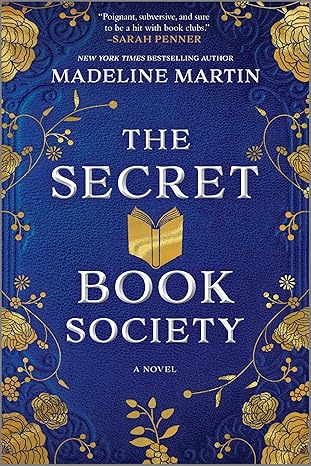
The Secret Book Society
I’ve read numerous novels about book clubs that take place in dark times, but those stories are typically about happier situations than the ones we encounter in The Secret Book Society. Set during a time when women could have their reading restricted by their husbands or fathers and were seen as so mentally deficient that fiction could drive them to madness, this book takes us to some dark places before showing the light at the end of the tunnel.
London, 1895: Eleanor Clarke is surprised to receive the missive. She and Lady Duxbury had barely exchanged any conversation the one time they had met, just a brief mention of a shared love of novels. Equally surprising is the manner in which the communication arrives – a note sent through her maid rather than by the post, advising that Eleanor will be invited to tea but that the event is really about a secret book society. The invitation to tea does indeed arrive, and Eleanor’s husband, a self-made man and a social climber, insists Eleanor accept the offer.
Wealthy American heiress Rose Wharton married the younger brother of an earl, assuming she would never carry the responsibility of representing the family name. Then her brother-in-law grew ill, and Rose suddenly found herself the object of scrutiny. No longer did her husband Theodore find her social foibles – and the ostracization they often caused – adorable. Now she is endlessly critiqued byTheodore and his family – as well as strangers – for her failure to perfectly fit into upper-crust English society. She loves her husband, but she can’t stand how cold and callous he’s become as he prepares to take on the mantle of head of the family. Rose had once given Lady Duxbury a novel when the two had taken refuge from yet another tedious ball in a powder room. Getting a note about a secret book society doesn’t surprise Rose, given that encounter, but it does concern her. What if this is just one more opportunity to be rejected?
While the invitation had been for her mother, she insists that her daughter, Lady Lavinia Cavendish, be the one to attend the secret book society. Beautiful but fragile, Lavina has struggled to make her way among the English elite. A betrayal by a jealous friend has left her in a precarious position, as well as extremely isolated. Lavina could use some new companions, but she doubts these older, married women will extend a welcome to her.
Fortunately, Lavina is wrong. All three of the other women had found themselves in a situation where reading fiction was blamed for their developing frivolity and other traits unbecoming of a lady. They care nothing for each other’s status, marital or otherwise, and more about their shared love of literature. This new club is intended to help them circumvent the restrictions placed on their reading material. Their hostess plans for them not just to share her extensive library full of novels but to develop friendships that will help them through the difficult situations they are in.
Those circumstances are challenging indeed. While Theodore loves Rose, he’s torn between her and his responsibilities to his family. His brother, the dying earl, is determined that Rose be brought up to snuff or severely punished. Not being accepted by the English peerage means that Rose’s only joys are the novels from Lady Duxbury and the friendship of the ladies she meets at the society. Lavina’s family allegedly loves her but feels that her social awkwardness and flights of emotionalism might mean she suffers from hysteria and needs to be in an asylum. Eleanor’s husband is the worst sort of abuser, barely letting her have any freedom. The books Lady Duxbury loans her – as well as the secrets the two ladies share with each other – are the only light in her bleak existence.
All three of our heroines are strong characters who have found themselves worn down by the patriarchal norms of their time. Eleanor and Rose, as married women, are disheartened by the power the men in their lives wield over them, and the laws that strengthen this imbalance leave them with few avenues of escape. Eleanor and Lavina have found that their beauty is a trap, drawing attention from unwanted quarters and making them objects of envy to the more foolish and mean-spirited among their peers. The fact that women often viewed other women as rivals for potential husbands or positions in society has left them isolated from potential help.
Lady Duxbury, as a wealthy widow, is in a unique position to help, and having suffered at the hands of her multiple husbands (she has had three), she has an intense desire to do so. While we learn the backstory of Rose, Lavina, and Eleanor early in the narrative, information about Lady Duxbury is gradually revealed throughout the text, with important details only emerging in the last twenty-five percent of the novel. She doesn’t receive as much page time as the other three, although she is pivotal to the plot.
There is romance here. Rose and Theodore (possibly) restoring their relationship is one aspect, and the courtship of Lavina and Mr. William Wright, a feminist who believes in women’s suffrage and does legal work to free women unjustly sent to asylums, is the other. Both are very secondary to the primary messages of how the freedom to escape into stories should be a right enjoyed by all, and how women should work together. The author can be a bit heavy-handed at times in making her point, but she does an excellent job of reminding readers of the history that makes it necessary, and I think most will forgive her.
I mentioned the story takes us to some dark places. It covers spousal abuse, marital rape, threats of incarceration in an asylum, a look at the horrors of one of those institutions, abuse and death of a child, poverty and starvation on the London streets, and murder as self-defense. The volume is written in such a manner that hope blossoms and blooms from the very first meeting of the book club in chapter one and we get to delight in the joy reading and friendship bring to these women’s lives from the start. But there is a lot of dark subject matter here before a happy ending is achieved for everyone. Not all of those HEAs include a romance but they do all include the love of family and friends.
We live in turbulent times, and surprisingly (or perhaps not) some seem to feel that treating women as equals is something we should reexamine. The Secret Book Society speaks powerfully to what we have to lose without sinking into endless exposition or preaching. I strongly recommend it to anyone who enjoys historical fiction or wants to be reminded of what life was like before women had rights.
Recent Comments



I love that it addresses how beauty can be a problem. It attracts unwanted men who don’t understand that you don’t appreciate their attention, and other women, instead of understanding, think you’re competition (sometimes for that guy you’re not interested in). It happens even today, but in the case of women under 30, I blame it on upbringing. Somehow, these women believe they must compete with other women to get a man who is perfectly mediocre in every way.
It’s a complicated situation for sure, but I think the author handles it well. It’s a great book.
This is on my TBR; it sounds deliciously complex.
It is. I absolutely loved it.