
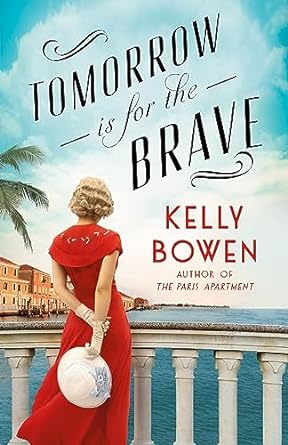
Tomorrow is for the Brave
Tomorrow is for the Brave is a beautifully written, mesmerizing story of a young woman coming of age against the backdrop of WWII.
The blurb for this book provides information about events up to and including the forty-percent mark. Those wishing to avoid spoilers for such a large portion should probably not read this review or that blurb.
In 1934, Violet St. Croix attends her first car race. Though she doesn’t yet know it, it will change her life in two crucial ways. The first is that she immediately falls in love with all things automotive. The second is that she meets a young woman named George, who kindly explains all about the racers and their vehicles. The two women part after their friendly encounter, but neither forgets the other.
Fast forward to June 1939. In the early dawn hours, Violet races her Alfa Romeo Spider down a shadowy street, dashing tears away from her eyes as she flees another intolerable celebration of an engagement she is beginning to regret. Her once charming fiancé has turned autocratic, and between him and her overbearing father, Violet can feel her life being slowly crushed. If she allows them to have their way, all that will be left is a shell of the woman she is and tatters of the dreams she has for her future. Her early morning drive is serendipitous. Violet almost runs over a man who turns out to be Henri, George’s brother. That encounter leads to Violet spending her free time helping his family keep their small shipping business afloat. Under the influence of her new friends, she finds the courage to ditch her fiancé, defy her parents’ wishes, and join the war effort with George via the Red Cross. She makes an abysmal nurse – the only position originally available to women – but a fortunate moment of crisis brings her driving skills to the notice of an important officer. He takes her to North Africa, where she chauffers French Foreign Legion personnel carrying valuable intelligence through the battle-heavy territory.
It’s a dangerous job, but Violet loves doing her part on the front lines. She also adores Commandant Lavigne, whom she regularly drives for. Her position as a Free French army adjunct comes with the benefit of regularly seeing George, a nurse working in the area, and Henri, a soldier, in the same arena.
When she is asked to liaise with an English officer on a confidential matter, Violet receives some disquieting information. Radio signals in the desert indicate there is a spy in their midst. Violet reads through the data, unsure what, if anything, to do about it. But when Commandant Lavigne is murdered shortly after they learn of the informer, she realizes the situation is more urgent than she had thought. Determined to ferret out the traitor, she tries to discuss it with her superiors to no avail. It will be up to Violet to find the Nazi agent working in their midst. But as suspicion seems to fall repeatedly on someone she cares about, will she trust her instincts that they are innocent or the evidence that points to their guilt?
This is an absolutely lovely story about hope, courage, and finding your niche in the world. Violet had never really belonged among the wealth and privilege her family enjoyed and feels far more at ease with George, Henri, and the rest of their family. Among them, she finds a practical use for her mechanical skills and a sense of camaraderie she never had at home. Once she joins up, working for/with the military intensifies the sense of accomplishment and satisfaction she feels from knowing she is contributing in a meaningful way. I loved how she gains strength from her friends and is able to become a source of hope and strength for many others as the story progresses.
Henri is our primary secondary character. Initially, he struggles with Violet. She, to him, is a representation of a class of people who take far more than they give and who exploit and endanger the people around them with little thought for those lives they consider ‘lesser’. Violet and his superior officers in the war show him how it is character rather than class that matters. It did bother me a bit that Violet has to prove herself to him at first, but I appreciated the beautiful friendship that builds between them as the narrative unfolds.
This is a wartime story, and Violet is caught up in one of the most dangerous spheres of combat, so we hear of hardship, death, and fighting quite a bit. The descriptions are well done, with the author striking a nice balance between giving us a taste of the horrors happening without overwhelming us with gore.
There is a romance here, but it develops towards the end of the book. Suffice it to say it is no surprise when it appears and in spite of its brevity of page space, I found it charming.
If I have a quibble, it is with the segments dealing with the spy. I didn’t like that we receive PoV pages from this character, and I found the storyline surrounding them a wee bit melodramatic. That didn’t in any way affect how much I enjoyed the story, but it did take a smidge of the shine off.
That said, Tomorrow is for the Brave is easily one of my favorite books of 2024 thus far. I recommend it to fans of WWII novels, fans of the author, fans of women’s fiction, and pretty much anyone who enjoys a good book.
Recent Comments



Adding this to my list
I thought this was a fantastic story. And the main character is based on Susan Travers, the only woman to serve in the French Foreign Legion.