
BookTok: Saviour of Reading or the Doom of Literature?

If you are a reader and you’ve lived on Planet Earth for any time over the last few years, surely you know about BookTok. Even if you aren’t a social media junkie or a TikTok expert, you’ve heard about how BookTok has made reading cool again and catapulted more than a few authors into successful careers (Colleen Hoover, Ali Hazelwood, Emily Henry, Rebecca Yarros, Sarah J Maas). In fact, in some circles BookTok + Covid19 has been credited with saving the entire publishing industry from certain ruin.
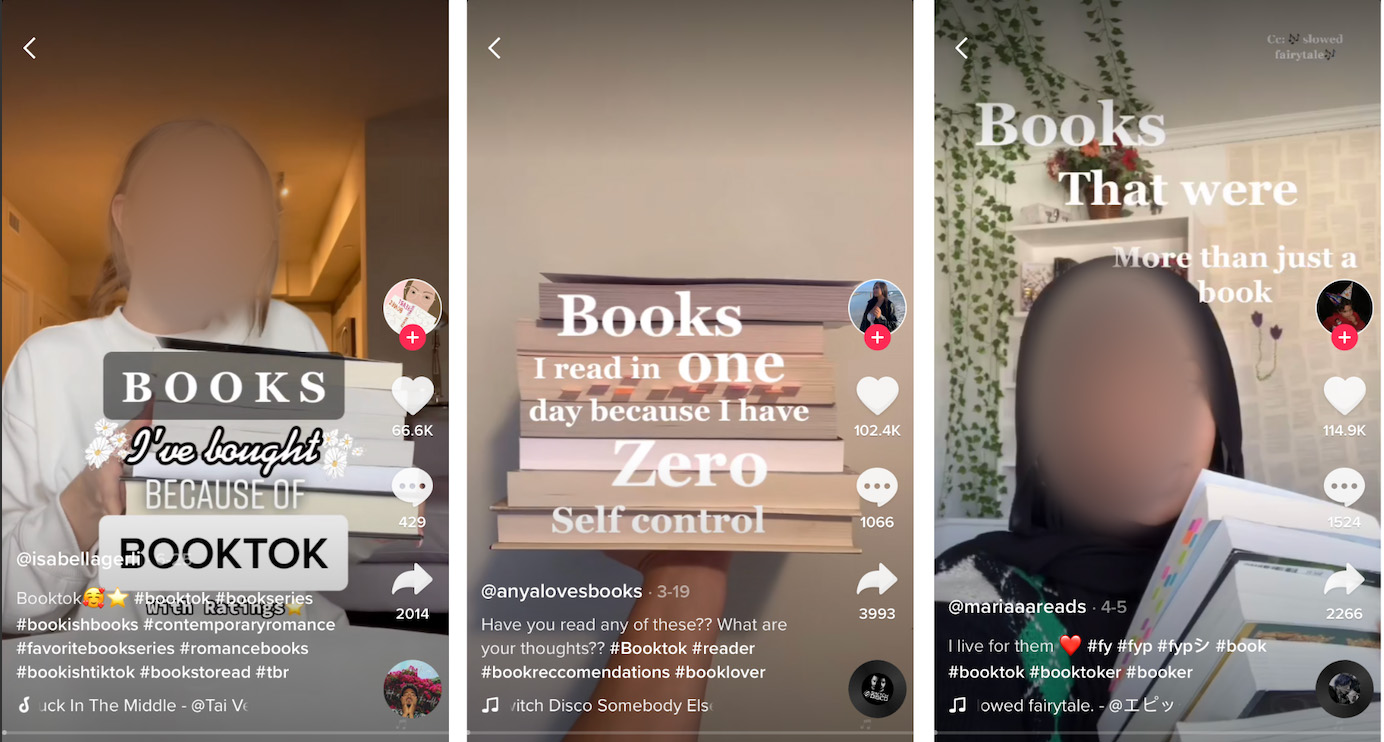
Essentially the world’s biggest online book club, BookTok is a virtual place to share a love of reading, to recommend and discuss specific titles and authors, and to get excited about news of upcoming releases. BookTok fans love the sensation of having “a friend” recommend a great read, as well as the entertainment inherent in any visual medium.
“‘You’ve got a real life person on the other end, and people build up a lot of trust in these users,’ said [Caley] Routledge, who said he particularly enjoys ‘aesthetic’ videos, where a user might show off their colourful, meticulously arranged bookshelf, and ‘book tags’, where users answer questions such as, ‘Which book would you love to read again for the first time?’ and then “tag” others on the app to answer too.” ~ The New Statesman
In addition to giving opinions about specific books, BookTok enthusiasts often virtue-signal their love of reading by a specific aesthetic. They buy dead-tree books rather than ebooks because physical books can be put on elaborately arranged bookshelves. They annotate what they read, sometimes with sticky tabs color coordinated to the book’s cover. They never buy one book when they can indulge in a “haul” of many. And, perhaps most baffling to me, they often present books with the spines turned away from the viewer.
While I can understand hiding spines in a video in order to maintain secrecy or suspense, I don’t understand why you’d do so on a bookshelf. WTF?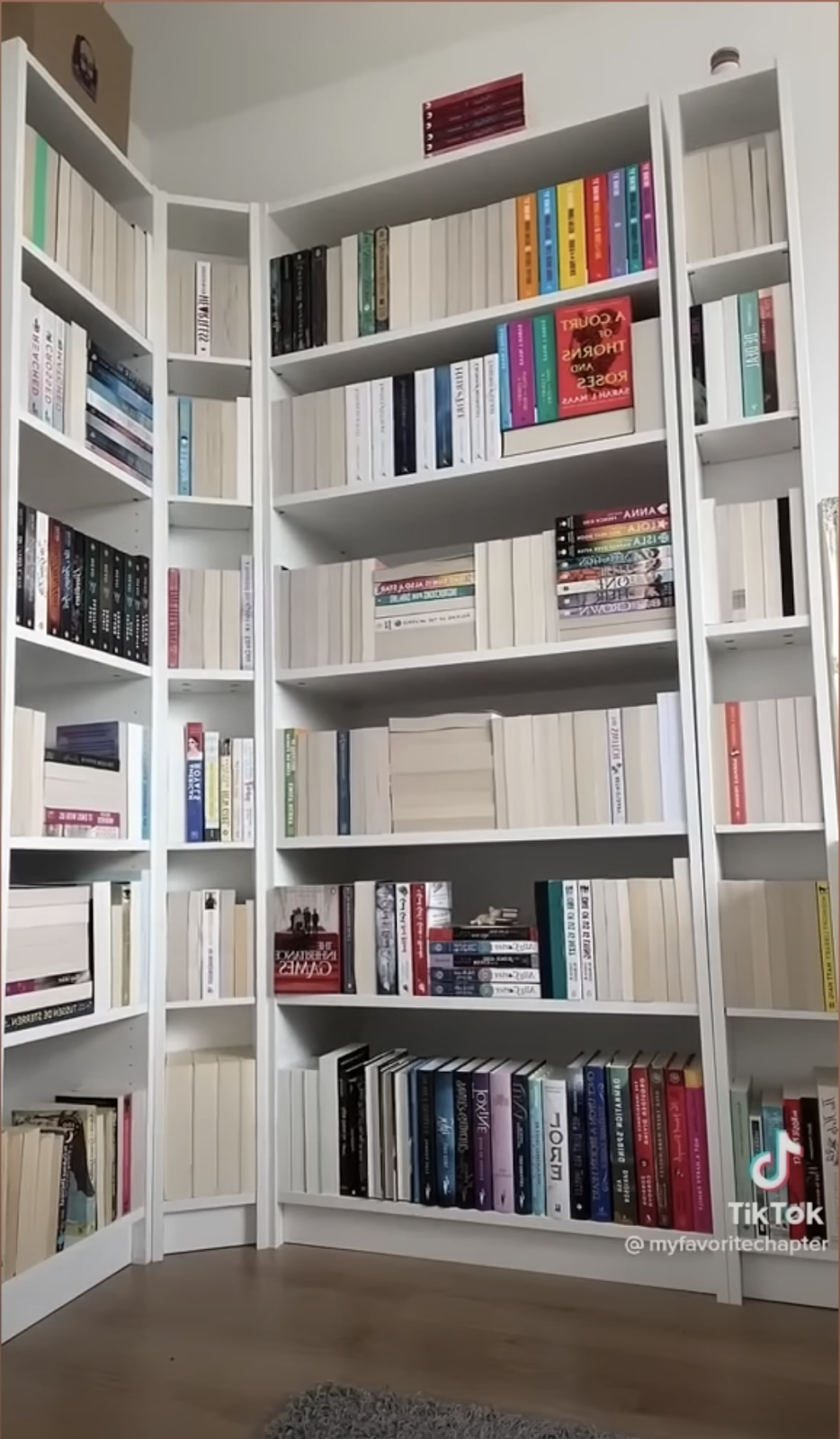
Side note: I have since learned that some readers shelve books that they have already read with spines in, leaving TBRs with spines facing out. I understand the theory but don’t like the look.
Anyway, there has been much discussion about how the BookTok phenomenon has affected the book industry and whether or not it is a net positive or negative.
Some have accused BookTok of being focused more on the image-bump one gets for being seen as an avid reader rather than actually being an avid reader. The emphasis on the markers of extensive reading – overflowing bookshelves, book hauls, reading goals based on quantity – seem to indicate this may be the case for at least a few.
Others bemoan the fact that BookTok emphasizes marketability over artistry (my argument as well). There are complaints about the relationship toxicity in so many of the most popular BookTok titles and how they are negatively affecting teen readers’ perceptions of what makes a healthy relationship. (Note: while I agree with the concerns voiced in the linked article, I do think it makes some outlandish accusations, such as it being self-published or older-generation writers who are pushing toxic books on innocent teens. 70% of TikTok users are under the age of 34, and Colleen Hoover is far from a self-published author these days.)
And then there is the competitiveness and cliques that always come with popularity.
On the flip side, some would argue that BookTok is a democratic system offering something for everyone. And that there is nothing wrong with promoting your love of reading through the aesthetics you adopt. Really, is it any different than the fan of a sports team buying all the team-branded merch they can get their hands on?
While I am always supportive of anything that encourages people to read more, my issue with BookTok is in how it elevates books and writers who don’t necessarily deserve the hype, especially when there are so many better options. What makes BookTok unique is the relative youth of its creators and consumers and their arguably amateur status as literary critics.
“BookTok is not dominated by the usual power players in the book world such as authors and publishers but by regular readers, many of them young, who share recommendations and videos of themselves talking about the books they love, sometimes weeping or screaming or tossing a copy across the room.” ~ The New York Times
Perhaps in backlash to the dry, thematic classics they are required to read for academic purposes in high school and college, these readers-for-pleasure are far more focused on presenting the emotional effects a particular story evoked than any actual storytelling merits it might offer.
The most popular videos don’t generally offer information about the book’s author, the writing or even the plot, the way a traditional review does. Instead, readers speak plainly about the emotional journey a book will offer.” ~ The New York Times
Not that these people are not wholly qualified to judge what they love or what brings them joy. Everyone is entitled and encouraged to read what they want to read without any apology at all. It’s when they begin to promote a book based only on this “emotions evoked” parameter as the reason for it being a “great” book that I start to have concerns.
Because given that BookTok posts are algorithmically controlled, as is all social media, variety and differing opinions are given almost zero weight. Popular content creators with high followings drive the discussion, with books and authors that they champion boosted into ever increasing exposure, creating a reverse-death spiral of sorts.
“Every time I went on TikTok looking for books, it seemed impossible to discover different fiction. It was the same 20 books over and over, reinforcing the idea that if you aren’t reading that Colleen Hoover book (no shade! Haven’t read!), you’re not in the club.” ~ Stephanie Danler, Bustle
When you constantly see the same twenty books or handful of writers appear in your TikTok feed over and over again, it’s easy to believe that EVERYONE loves that book/writer and there must be some legitimate reason for that love. But there is never any discussion of specific reasons why that book/writer deserves the hype they’re receiving. You’re just supposed to agree, and if you don’t love the book/writer or find faults, there must be something wrong with you, or you missed some key component, or you simply didn’t read the book. Dissent is not tolerated, honest debate not welcomed.
And this is where traditional book review sites like this one come into play. Because while there is absolutely nothing wrong with loving a book that makes you feel a certain way, I believe there is still value in examining the actual components of a story when offering a review. I’m not talking about personal preferences determining “good” vs “bad”, but rather evaluating the mechanics of storytelling, such as plot, characters and writing before making a final call on a particular title’s merits.
When I pick up a book that has received rave reviews and a lot of positive hype, there are certain things I expect to find. I expect the writing to be solid and have passed through an editorial process. I expect characters that are realistic and relatable (they don’t have to be likable!) and who make understandable choices given their circumstances. I expect plots to make sense in general, and any worldbuilding to have a consistent internal logic. In the end, I may not like a story for a variety of reasons, but at the very least I expect that I won’t be pulled out of it by process issues.
But too often, this is what I encounter when I read a highly touted BookTok book. Not all the time of course, but in may cases, the writing will be downright bad or in desperate need of deep editing. Or maybe the plots will have massive holes or contradict themselves. Characters will be shallow or stereotypical or TSTL, and tropes will be used only to make a book more marketable rather than as useful tools for good storytelling. When I encounter these poorly written books, I scratch my head in bafflement and am filled with a sense of frustration and disgust that it’s being promoted as “amazing” and “so good” and “the best thing I’ve ever read!”
Personally, I can’t have any feelings about a book that I can’t actually read because the mechanics are so distracting. I suppose I envy those who can overlook problems and focus on the feels. If you are one of those readers, good on you!
But books cost a lot of money, even ebooks, and there is nothing more frustrating than purchasing a much-lauded book only to want to throw it against the wall. So, I’ve made it a goal to read books that are hyped on BookTok to see if I personally think they deserve the praise and to post honest reviews on this site of why I think as I do. I understand that this is 100% subjective, and what sinks my boat may be what floats someone else’s. But as I said before, there is value in seeking out opinions outside the world of BookTok.
And to prove that I’m not here to simply bash BookTok hits, here is a non-exhaustive list of BookTok favs that have gotten (mostly) positive reviews at AAR.
Archer’s Voice by Mia Sheridan (B+)
Beach Read (B)
Better Than the Movies by Lynn Painter (A-)
Boyfriend Material by Alexis Hall (A)
Bride by Ali Hazelwood (B+)
The Bromance Book Club by Lyssa Kay Adams (B+)
Bully by Penelope Douglas (D-)
The Cruel Prince by Holly Black (A)
The Deal by Elle Kennedy (B)
Delilah Green Doesn’t Care by Ashley Herring Blake (A-)
Divine Rivals by Rebecca Ross (A-)
Fourth Wing by Rebecca Yarrows (A/D+)
The House in the Cerulean Sea by TJ Klune (A)
The Husbands by Holly Gramazio (A)
Icebreaker by Hannah Grace (C+)
Ice Planet Barbarians by Ruby Dixon (B-)
It Happened One Summer by Tessa Bailey (A-)
The Kiss Quotient by Helen Hoang (A-)
The Love Hypothesis by Ali Hazelwood ( C)
Mexican Gothic by Silvia Moreno-Garcia (A)
People We Meet On Vacation by Emily Henry (B+)
The Priory of the Orange Tree by Samantha Shannon (A-)
Red, White and Royal Blue by Casey McQuiston (B+)
The Song of Achilles by Madeline Miller (A-)
The Spanish Love Deception by Elena Armas (B)
Tomorrow and Tomorrow and Tomorrow by Gabrielle Zevin (B+)
These Violent Delights by Chloe Gong (A)
Verity by Colleen Hoover ( C)

I think BookTok is, at large, all about the reviewers you follow. You’ll get a lot of that samefacey Colleen Hoover stuff, but there are people out there reccing POC authors and diverse books who deserve attention.
On the popularity vs. value point below, the version I grew up with was “If fifty million people say a foolish thing, it is still a foolish thing.” Searching just now, one quote site attributes that to Anatole France, but another site lists variations from Oliver Goldsmith in 1766, J. A. Schmit in 1874, and W. Somerset Maugham in 1901.
This is a fascinating take, IMO.
https://www.tiktok.com/@bookishwithb/video/7406051105794182433
She makes some good points, especially about getting shouted down by people who didn’t even bother to try to understand her point.
But that’s social media today, it seems.
I’ve always been leery of the idea that there are intellectually valid books vs. popular buzzy books. That said, the monetization of book reviews certainly makes finding books you the reader might actually like harder.
Yes, I wasn’t really with her on the intellectual/popular, but I agreed with pretty much everything else she had to say.
We can choose who we want to follow on TikTok. I follow my favorite reviewers (and authors) that have similar likes and dislikes as I do and I enjoy their reviews. I can also follow people on Instagram, Goodreads and other social media platforms. I compare this to having a favorite reviewer at AAR or a friend that likes similar books.
I confess, I find the interface overwhelming.
When I started on TikTok a few years ago and wanted to know more about it, the tech person at my library helped answer my questions along with the help of a group of middle schoolers that were there.
I honestly can’t be bothered with it, for pretty much the same reason. I’m not the target age-bracket (not that I’m a technophobe) and I pretty much know where I can find out about the books I’m likely to want to read. And chances are, if I miss out on something good that showed up on BookTok it will quickly filter through to places like Goodreads and other review sites, so I’ll find out about it from my usual channels.
I think that is key to a successful experience-find BookTok people who generally like the same books as you do so that your feed is tailor-made for you. I think the bigger issue is for new readers who don’t even know what they like yet – they see the same 20 or so books hyped over and over again and assume that these are “the best” whether or not they deserve that designation.
I tend to look at Goodreads for how readers really view popular books.
See, I have a hard time with Goodreads. I can’t say how many times I’ve read a book, thought it terrible, then found out it had a super-high rating on Goodreads. What I do is read the 1 and 2 star reviews of these Goodreads Superstar books and this helps me get an idea of what I might not like.
Same. I’ve just read a book for review that has loads of 4 and 5 star reviews – it’s a 2 for me. I always look for the lower grade reviews as they are the ones that often flag up the stuff I know I’ll find problematic, too.
We all love different things!
Exactly. I see a lot of people who say “this book got one star on Amazon because the review said there was too much sex – I’m buying it!”
It’s not how my mind works, but boats float in many different ways!
I too look at all the reviews.
AND, I believe that if 50K people love a book and you don’t, it’s unlikely that it’s a terrible book. It’s a terrible book for you.
I don’t know if you remember the hip-hop harem pants of the 80s with the crotch at the knees, but lots of people wore them. They weren’t bad for any particular person; they were just bad, period. If you look at fascism, it is often popular but never good. Popular doesn’t mean bad (think of Harry Potter and Hunger Games, which are excellent and popular), but I don’t think we can say it means good, either. Humans are herd creatures, and sometimes our desire to be part of something makes us inclined to give a stamp of approval, to be with the in-crowd so to speak, on items we don’t genuinely like and will be embarrassed to have pictures of ourselves with in ten years. Just my .02 but way more than 50k people have flocked to things that are categorically bad. Their love for that thing doesn’t make it good in any way.
With books, popular novels may speak to a moment. I wouldn’t call The Flame and the Flower by Woodiwiss a good book but something about it spoke to that moment. And that’s okay. I don’t know if we need to quantify our leisure activities as good or bad. Their value can come from our enjoyment of them. I like Twilight by Stephanie Meyer. A lot of people hate it. I can see their point – they look at it through a social lens and wonder if Bella is an appropriate role model or representation of women. I look at it through a sci-fi lens and like the idea of being pulled by fate towards particular places and people and realizing how pivotal our choices can be and how emotions over reason often drive them. I think how we look at a book. the lens we read it through can impact how we see it. I certainly expect different things from different books so I would imagine others do too. When I read reviews, I look for why the person liked or hated the book. It just may be that their reason for liking it would be my reason for hating it – an vice-versa. Also for what the author was trying to accomplish – is it a romance? If so, was it romantic? Long winded way of saying popular doesn’t mean good or bad. Just good marketing or the good luck to appeal in the moment. Malcolm Caldwell’s The Tipping Point has some good stuff to say about that.
I was just in India and those pants are everywhere! So, again, maybe for you, they will always be not good. But for others, they work.
For me, The Flame and the Flower was a good book for the bazillions who loved it. And I’m always wary when we dismiss emotional stories–a reasonable rom com will be panned by critics who then slaver over a Mafia based movie where the plot is iffy and the body count high. Our cultural critics have always loved angst and depth rather than joy and comfort. To me, both are worth praising.
So, I guess I’d say both things are true. Not all things that we love at a time in place will be, in our judgement later, worth that adulation. AND I will always side eye the idea that just because it is popular doesn’t mean it isn’t great.
Oh, I would agree that being popular doesn’t mean not being great. Just that it also doesn’t give intrinsic value to anything. But we could be talking about great in different ways, too.I loved The Flame and the Flower, but that is very much past tense. I know a lot of people who read it then and agree it doesn’t stand the test of time. And that is what makes something great to me. When it passes the ten year anniversary, do I still love it?
I think what is great for an individual is incalculable. What is deemed great by society is a different thing.
I’ve never liked The Flame and The Flower so it’s never been great to me. But the culture calls it a classic. I do however still love Prisoner of My Desire, a book that many, by current cultural mores, currently consider a no go.
Thank you, Maggie. You’ve said exactly what I wanted to say. There are many many things out there that are popular, but that doesn’t make them intrinsically good.
I’m not sure any art is ever intrinsically good. It’s always colored by individual, temporal, and social mores and values.
I have to take issue with that. Beethoven’s Eroica Symphony? Michaelangelo’s David? It’s pretty hard to argue that they aren’t intrinsically good – their creators knew what they were doing and worked hard to perfect their skills – art like that transcends social mores and values, IMO. Someone else might not like a particular piece of art (I can’t stand Wuthering Heights!) – but it doesn’t mean it’s not intrinsically good.
I think Wuthering Heights is intrinsically terrible!
Intrinsically is the issue for me. I’m not sure that those from non-Western cultures would say that either Beethoven or the David is intrinsically good to them.
I’d agree that within large swathes of humanity, there are things many many of us would say are phenomenal works of art. But I don’t believe there’s some standard that is always and forever true for all.
This is a tough one for me. I see what you’re saying, but this is the very problem I have with BookTok. I don’t think that just because a lot of people like something means it’s inherently “good”, and that if you personally don’t agree with that, then the problem isn’t with the book but rather your personal tastes. I defer to my review of Fourth Wing. Many many many people love that book. And that’s fine – they like the story and the way it makes them feel, etc. and that is all totally valid. I am not judging or saying they are wrong or that they shouldn’t love it. Not at all. But when you start to break the book down into the components that one evaluates to determine if the book is “good”, you find problems. So just because it reaches a certain threshold of # of people who “like” it doesn’t make it good by default. It’s like Twinkies. They are yummy and lots and lots of people love them. But no one can argue that they are good for you, or that they involved craft or skill to make…they rolled off a factory conveyor belt. I think it’s really telling that for most books that are huge raves on BookTok, you will find a huge polarization about the book – it’s either loved or reviled, but rarely in the middle. Because people who love it are able to ignore the problems that exist in the book (a war college that kills 75% of its students despite needing warriors to fight a century-old war) while those who can’t ignore those problems call them out.
I think your Twinkie analogy strikes to the heart of the matter. Many folks like Twinkies in part due to pricing, accessibility and convenience. A lot can contribute to popularity that doesn’t translate into genuine value.
Good for you is a whole ‘nother kettle of fish. I’d argue that in and of themselves Twinkies are great. They’re bad for you, sure. But the Twinkie was a brilliant concoction.
I have spent years hearing that women’s stories aren’t intrinsically good, that stories that venerate putting love over work are trite, that oral histories or folk art aren’t anywhere near as valuable as the works that our cultural critics love.
So, while I agree that not all that is loved is great, I struggle mightily with the idea that there’s a set of characteristics that make art or literature great. It’s my sense that we overlook the flaws in that which calls to us and tend to more critical of those in works that don’t.
The problem with that is that as book reviewers, when we assign grades we tend to imply that there is something wrong with an F book beyond this just didn’t work for me. And that an A has something really right with it. For me, the great value of an AAR review is that it lists quantifiable reasons beyond I loved this. Even with reviewers I agree with I find books they loved that I hate. I need quantifiables to make my decision. In the end books are a purchase and a product. For me to buy you have to convince me it’s great.
I completely agree! AND I don’t think that means there’s a set of standards that mean a book is inherently good or bad.
If I review a book that lifted me up and made me happy to be alive, I might persuade you that it will do the same for you. Or if I hate a book with too many–IMHO–twists at the end, I might convince you it’s a C read.
Nothing is black or white–we’re talking about shades of grey as well as what each of us thinks constitutes excellence.